

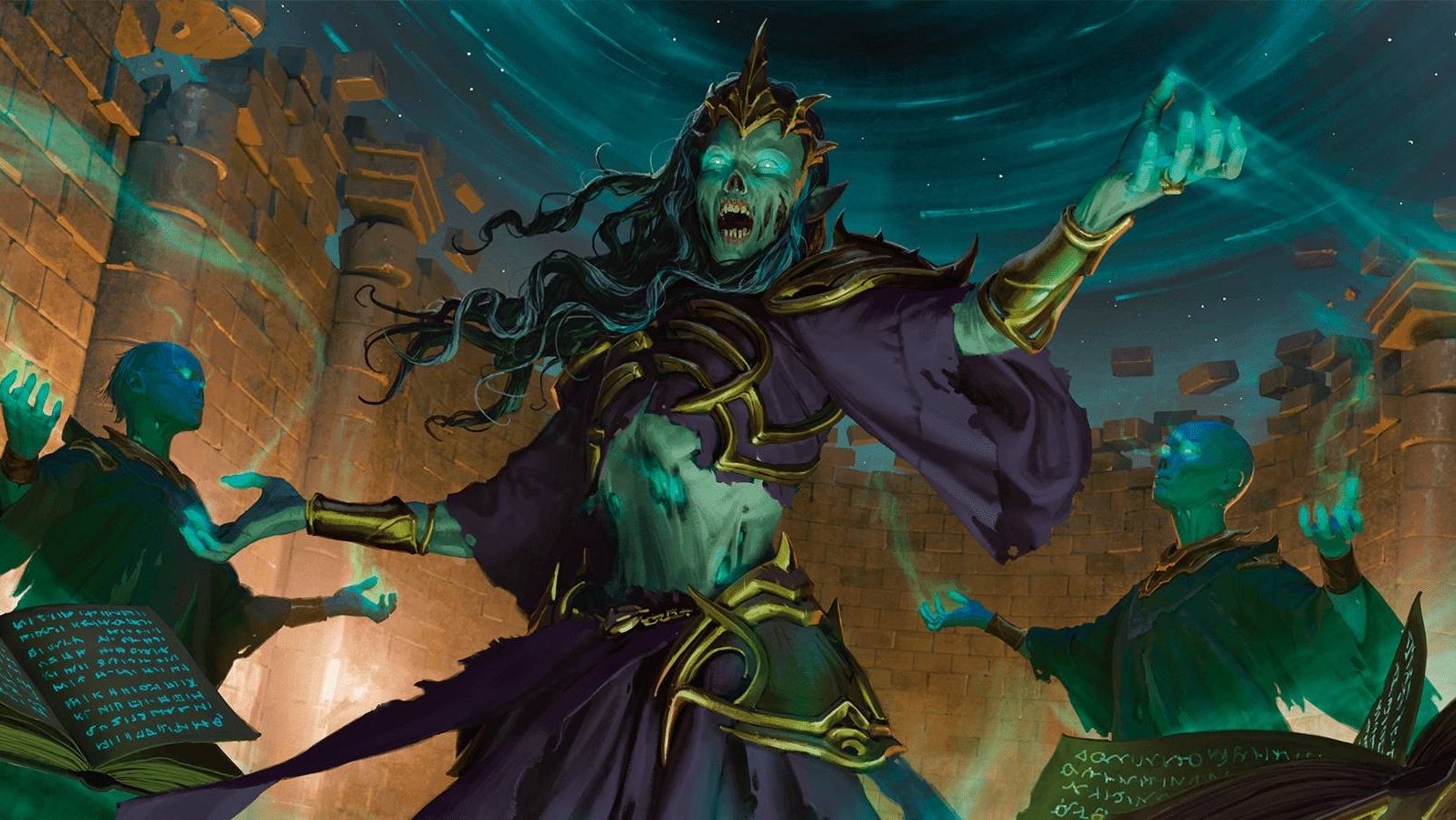
Image credits: Art by Viko Menezes
The Preamble
Unearthed Arcana is the system that the Dungeons & Dragons developers use to showcase and source playtesting for upcoming content for D&D. After a designated “playtest period,” players will have a chance to submit feedback via surveys on dndbeyond.com. In this post, I’ll cover the most recent Unearthed Arcana article, published on April 2nd, 2026: Villainous Options. Specifically, I will be looking at the new Paths of Villainy: The Path of the Death Knight and the Path of the Lich.
Note: This post assumes you have read (or at least skimmed) the content covered in the Unearthed Arcana article linked above. If you have not read it, you may find it useful to have it open in a separate tab.
Content Warning:
The above UA and the material below contains or may contain descriptions of body horror, disease, insects, and demons that some readers might find disturbing.
What is a Path of Villainy?
A “Path of Villainy” is a collection of feats that are meant to be taken in sequence and mechanically complement each other. This is a new way of presenting this kind of system, but we’ve seen this concept before in a number of previous D&D books, including recent releases like Forgotten Realms: Heroes of Faerûn and Eberron: Forge of the Artificer. Those books and more have feats that require other feats as prerequisites: For example, taking the Purple Dragon Rook Origin feat enables you to later take the Purple Dragon Commandant feat. The only real differences are that there are more options in each path, and each path comes with its own flavor text. It might sound complicated, but once you get into the mechanics, it’s very simple.
Path of the Death Knight
Right off the bat, I really like that these paths go in-depth on flavor before tackling mechanics. The “single shameful act” that causes a character to turn from righteousness to villainy is a classic trope, and the provided Death Knight Journeys table could really help get the creative juices flowing. One of the nice things about both of these paths is that they are based on existing monster stat blocks, so if a character reaches a “point of no return” and they leave the party, the DM has an easy way to bring them back as a villain in the future. Of course, use session 0 and conversations with your DM to figure out if that’s a story you should consider telling with your group.
Death Knight Initiate
This is the first feat on the Path of the Death Knight, and it is a prerequisite for all subsequent Path of the Death Knight feats. In order to take this feat, you must be Level 4+, and you must have the Weapon Mastery feature. This means the feat (and all subsequent feats) are only accessible for Barbarians, Fighters, Paladins, Rangers, and Rogues, although as we’ll see shortly, they’re most valuable for Fighters and Paladins.
The feat comes with three benefits. First, it grants an Ability Score Increase that allows you to increase your Strength or Charisma score by 1. Next, it gives you a number of Death Points equal to your Proficiency Bonus. You can use these Death Points to fuel features from this feat and subsequent Path of the Death Knight feats; you regain all expended Death Points when you finish a Long Rest. Finally, it gives you Dread Strike, which lets you spend Death Points (or any spell slots you have) to cast Wrathful Smite, a spell that adds 1d6 Necrotic damage to a successful attack with a melee weapon (or Unarmed Strike) and potentially frightens the target for 1 minute on a failed Wisdom saving throw. Notably, when you cast Wrathful Smite with Death Points, the target has Disadvantage on saving throws against the spell (which is based off your Charisma).
So why is this only good for Fighters and Paladins? The first reason is the Ability Score Increase. Strength and Charisma are often useful for Fighters and Paladins, but rarely for Rangers or Rogues. A Strength-based Ranger or a Rogue that uses True Strike could potentially get some good value out of this, but it would probably still be an uphill battle; not to mention, Rangers that want Wrathful Smite could also pick it up through the Shadow Touched feat, and with Wisdom as the spellcasting ability. Of course, Barbarians love Strength, but they run into a different problem: They can’t cast spells (like Wrathful Smite) while Raging. In other words, this feat competes with the class’s features instead of complementing them, making it really hard to use effectively. But for a Fighter or a Paladin, this is pretty good. Although it’s not the best smite spell in game, Wrathful Smite at least offers a good mix of damage and control. Paladins will appreciate the extra smites (even if they don’t do as much damage as Divine Smite), and Fighters will appreciate the chance to smite. I would hesitate to take this before Great Weapon Master (if I’m using a heavy weapon) and/or Mage Slayer, but if I already have both of those feats and I’m playing an evil-aligned character, I would definitely consider this.
Dread Authority
This is one of four “mid-level” Path of the Death Knight feats. The only prerequisite for this feat is that you have the Death Knight Initiate feat, but of course that means you needed to meet that feat’s prerequisites as well. In any case, this feat grants you two benefits. Like Death Knight Initiate, it grants an Ability Score Increase, but this one increases your Constitution or Charisma score by 1, instead of increasing your Strength or Charisma score. Next, it gives you Dread Command, which enables you to cast the Command spell by expending Death Points (or with your spell slots). When you cast the spell using Death Points, any Undead creature that you target with the spell has Disadvantage on its saving throw (which is, once again, based off of your Charisma). Before anyone familiar with the 5e version of Command objects, in 5.5, there is no longer any restriction against targeting Undead with the spell.
I don’t love this one. There are a couple of problems here. For one, even though Command is a good spell, you can achieve a similar level of control with simple adventuring gear, like Chains, Nets, and Ropes, or even Wrathful Smite, which you already have if you’re taking this feat. Command is usually better than those when it works, but not so much better that it’s worth a feat by itself. And if you’re going to take a feat to get access to Command, there are better feats (like Magic Initiate and Fey Touched) that can give you access to it and let you choose your spellcasting ability.
Plus, like we established last time, these feats primarily benefit Fighters and Paladins. Paladins already have Command on their spell list, so they don’t need this feat to access it. Thus, it’s really only appealing for Fighters. But in order to use this, they have to give up the Death Points they were using to cast Wrathful Smite. Long story short, everything here has an opportunity cost that I find hard to justify.
I don’t think this feat is a lost cause, I just think it needs a little bit of work. Giving Undead Disadvantage on their save against the spell is a fairly situational benefit. However, if you could instead expend additional Death Points when you cast Command with this feat to affect multiple targets (effectively allowing you to upcast it), then it would be way more worthwhile. Alternatively, maybe when you cast it with Death Points, you automatically cast it as a 2nd level spell. Considering the cost of taking this feat, I don’t think either of these solutions would be overpowered.
Harbinger of Doom
This is the second of the “mid-level” Path of the Death Knight feats. Again, the only requirement for taking this feat is that you also have the Death Knight Initiate feat. When you take this feat, you increase your Strength, Constitution, or Charisma score by 1, you always have the Bane spell prepared (do you feel in charge?), and you can cast it with a spell slot or by expending Death Points. When you cast the spell with Death Points, creatures that fail their saving throw against the spell subtract 1d6 from their attacks and saves instead of 1d4.
I like this feat a lot better than the last one. Bane doesn’t get as much love as its counterpart, Bless, but it’s potentially just as good. It targets a Charisma save, which a lot of enemies struggle with, and the effect is great when it sticks: -1d4 from your enemies attacks and saves (or effectively +1d4 to your allies’ AC and save DCs). And that’s just when you cast it with a spell slot; casting it with Death Points makes it even better. I wouldn’t take Death Knight Initiate just so I could have access to this feat later on, but if I’m already planning on taking some Path of the Death Knight Feats and my party targets a lot of saving throws, I’d definitely consider this one.
Deathly Presence
The third of the “mid-level” Death Knight feats, this one requires you to have Death Knight Initiate and be Level 8+ (really only prohibits Fighters from taking it at Level 6; every other class is unaffected). This feat increases your Strength, Constitution, or Charisma score by 1, you always have the Fear spell prepared, and you can cast it with a spell slot or by expending Death Points. When you cast the spell with Death Points, any creature that fails its saving throw against the spell takes 2d6 Psychic damage.
This is spectacular. Fear is a great spell, a contender for the best 3rd level spell in the game, and unlike Bane or Wrathful Smite, you can’t gain access to it from other feats. That on its own feels like all I have to say; if you could get Fireball or Hypnotic Pattern from a feat, wouldn’t you at least consider it? Moreover, this feat pays for its own resource cost. With Death Knight Initiate, you could spend one Death Point to deal 1d6 to an enemy and potentially frighten it. With this feat, you can spend one Death Point to potentially deal 2d6 damage to multiple enemies and frighten them. Mechanically, this feat is probably the best argument for taking Death Knight feats in the first place.
Two weird things about the wording of this feat. First, the inclusion of “average damage”—saying “7 (2d6)” instead of just “2d6″—feels like a mistake, and might confuse new players that aren’t familiar with that kind of notation. Second, it’s not clear if targets take 2d6 damage each time they fail a save against the spell, or if they only take the damage when they fail their initial save.
Unholy Steed
The last of the “mid-level” Path of the Death Knight feats, with the same prerequisites as Deathly Presence. This feat increases your Strength or Constitution score by 1, to a maximum of 20. A character with this feat also always has the Find Steed spell prepared, and can cast it with spell slots or Death Points. When you cast Find Steed with a Death Point, the summoned Steed is always a Fiend, and targets you choose have Disadvantage on their save against the steed’s Fell Glare.
If this feat is the reason you don’t take Deathly Presence as a Death Knight, then you’re forgiven. It’s really good. Find Steed is another great spell, and it’s even harder to get than Fear. Now, to be fair, Paladins already get Find Steed and can cast it once per day for free. However, if you’re playing a Fighter (or even one of those unorthodox Ranger or Rogue builds I mentioned earlier), this is a huge boon. Mounts in D&D aren’t always easy to come by, but if you can get one, you’ll quickly realize how powerful they can be. They’re not just great for you, though; they can also be great for support and utility. If you don’t need to use your steed, pass it off to another party member who needs the mobility; if you need to check for traps, send your steed in first and then resummon it when it dies. That’s not a strategy I’d normally go for, since I tend to play good-aligned animal lovers, but if I’m going to be evil, my character probably won’t have any reservations about sending my fiery nightmare steed to its doom; especially because the cost to resummon it is pretty cheap.
Once again, a weird wording quirk in this one: “targets you choose have Disadvantage on the Wisdom saving throw against [the steed’s] Fell Glare.” Fell Glare only targets one creature, so there’s no risk of friendly fire; it seems like it should just say “targets have Disadvantage on Wisdom saving throws against [the steed’s] Fell Glare.” I guess the idea is that you still get to choose in case the Steed gets charmed, but I’d go for the simpler wording (even if it’s technically a nerf), because that’s such a niche scenario.
Death Knight Ascension
This is the final feat on the Path of the Death Knight. To take this feat, you must be Level 12+, and you must have at least two other Path of the Death Knight feats (in other words, you need Death Knight Initiate and at least one of the mid-level feats we just covered). This feat increases your Strength or Charisma score by 1, to a maximum of 20, and changes your creature type to Undead. You also have Resistance to Necrotic and Poison damage, and you don’t gain Exhaustion levels from dehydration, malnutrition, or suffocation. Finally, as a Magic action, you can expend between 1-5 Death Points to hurl an orb of hellfire at a point you can see within 120 feet—remember what I said earlier about “taking a feat for access to Fireball?” The orb has a 20-foot radius and deals 4d6 damage per Death Point expended (half Fire, half Necrotic), with a Dexterity save for half damage (the DC is based on your Charisma).
A lot of fun stuff here. Changing your creature type to Undead does have some mechanical benefits (immunity to spells like Hold Person and Antilife Shell, for example) and is really cool thematically, especially for a Construct character like a Warforged or Autognome (although admittedly there’s some overlap between the benefits of this feat and those species). The Unholy Anatomy benefit (the part that gives you resistance to Necrotic and Poison) damage is also solid since I believe those damage types are fairly common, and while it probably won’t come up all the time, being immune to suffocation can occasionally be useful for stealth or survivability.
But let’s be honest, the big thing here is the Hellfire Orb. It only takes 2 Death Points to make this as good as Fireball. 4 Death Points is twice as good. 5 Death Points is basically a multi-target Disintegrate. Yes, Meteor Swarm does more burst damage than the highest-level version of this. But I can’t think of anything else that does. Of course, spending all of your Death Points on this isn’t usually advisable; you probably want those for Fear or Find Steed; but when the opportunity presents itself, it’s going to feel so good to roll all those dice.
I wouldn’t normally recommend using the lowest-level version of Hellfire Orb. Unless it’s your only option for damage, you’ll usually be able to deal damage more effectively with your Attack action. The only situation where you might use that is if you have a bunch of enemies (at least 4) grouped up that you know are all at low HP.
Path of the Death Knight: Final Thoughts
I really like a lot of the ideas here. My main problem is how restrictive the path is. As I pointed out earlier, the fact that you can only increase Strength or Charisma with Death Knight Initiate means this path is going to be really hard to access for anyone that’s not a Fighter or Paladin, even though a Death Knight Ranger or Rogue could both be really fun. Some sort of change that makes those builds possible would be really nice.
Path of the Lich
This path is less about a “single shameful act” and more about a reckless pursuit of immortality; another classic trope. The Lich Rites table provides several story prompts for how you might begin your journey towards lichdom. Even though these prompts are more specific than the ones in the Death Knight Journeys table, I find them less evocative overall. Still, I’m glad the table exists, and it serves its purpose.
Lich Initiate
This is the first feat on the Path of the Lich, and it is a prerequisite for all subsequent Path of the Lich feats. In order to take this feat, you must be Level 4+, and you must have the Spellcasting or Pact Magic feature. This means the feat (and all subsequent feats) is accessible to Bards, Clerics, Druids, Paladins, Rangers, Sorcerers, Warlocks, and Wizards; oddly enough, it’s easier to become a lich than it is to become a Death Knight.
The first benefit of the feat is an Ability Score Increase that allows you to increase your Intelligence, Wisdom, or Charisma score by 1. When you take this feat, you also create Spirit Jar out of a Tiny object that is of great significance to you. The Spirit Jars table offers several suggestions for what your Spirit Jar might be; it doesn’t have to be an actual jar. Make sure to store the jar somewhere safe! The jar has an AC equal to your Spell Save DC, but it only has a number of Hit Points equal to your spellcasting ability modifier + your character level; and if the jar is destroyed, you gain two levels of Exhaustion. Which is bad.
The actual “ability” here is called Soul Siphon. When you reduce a Humanoid enemy to 0 Hit Points (or a Humanoid enemy within 10 feet of you is reduced to 0 Hit Points), you can consume its soul. This not only prevents the creature from being resurrected by any means short of a True Resurrection or Wish spell, but it also increases your damage. On your next turn, the first creature you hit with an attack takes extra Necrotic damage equal to 1d6 + your spellcasting ability modifier.
Soul Siphon is good. Over the course of a campaign, this could yield you a lot of extra damage, and spellcasters don’t have a ton of ways to get extra damage from feats, so this is actually really nice. I also think it’s pretty well-balanced: I would consider it comparable to the Sentinel feat overall. The emphasis on attacks is interesting, though; weirdly enough, a Barbarian would benefit more from this feat than the Path of the Death Knight feats (of course, they’d need a level in a spellcasting class to gain access to it).
You should definitely talk with your DM before you decide to take this feat, though. If you’re doing a Monster Hunter-style campaign that mostly involves battles with Monstrosities, or you’re crawling through the nine hells and dealing primarily with Fiends, this feat will rarely come into play, since its effect only triggers against Humanoids. The feat could also lose some points depending on how your DM handles the Spirit Jar: If they’re going to relentlessly target it with attacks and spells, this feat will end up being more of a burden than a boon.
Arcane Restoration
This is one of three “mid-level” Path of the Lich feats. In order to take this feat, you need to have the Lich Initiate feat. When you take this feat, your Intelligence, Wisdom, or Charisma score increases by 1, and you gain the Essence Rejuvenation ability, which lets you to regain expended spell slots when you consume a soul with Soul Siphon. The expended spell slots can have a combined level no higher than 4 (so four 1st level slots, two 2nd level slots, etc.). Once you regain spell slots with this ability, you can’t do so again until you complete a Short or Long Rest.
This is pretty great, especially for half and 1/3rd casters. Spell slots are valuable resources, and it can be hard to have enough. The ability to regain a couple just by reducing an enemy to 0 Hit Points is really nice, although again, the enemy has to be Humanoid, which isn’t a guarantee. I think it might err on the side of being too powerful though; getting potentially two extra 4th level spells per day as early as Level 8 is pretty strong. I think that either the combined level of regained spell slots should be no higher than 3, or this should be limited to once per day.
Transfer Life
This is the second mid-level Path of the Lich feat, with the same prerequisites as Arcane Restoration. When you take this feat, your Intelligence, Wisdom, or Charisma score increases by 1, and you gain the Soul Transference ability, which lets you distribute Temporary Hit Points when you use Soul Siphon to consume a soul. The amount of Temp HP equals your Proficiency Bonus + your spellcasting ability modifier.
This feat is mid. Unless you’re playing an Intelligence caster, you can get a way more reliable source of Temp HP from Inspiring Leader. And although this makes you as an individual more durable than Inspiring Leader would, in order to catch up with the amount of Temp HP that Inspiring Leader distributes overall, you have to consume between 7-10 Humanoid souls per rest (depending on character level, and assuming a party of 4). And that’s assuming that you’re consuming those souls at a convenient time; if you reduce an enemy to 0 and nobody’s out of Temp HP, then it takes even longer to catch up. If you want to book it for the Lich Ascension feat (the last feat on the Path of the Lich) but you also want something like Inspiring Leader, then maybe this feat is worth taking. But if you just want to be a good source of Temp HP for the party, I don’t think this is the feat for you.
Undead Grasp
This is the last mid-level Path of the Lich feat, with the same prerequisites as the last two feats. When you take this feat, your Intelligence, Wisdom, or Charisma score increases by 1, and you gain the Paralyzing Touch ability. This ability teaches you the Chill Touch cantrip (or another cantrip of your choice, if you already know Chill Touch). Additionally, when you deal damage with Chill Touch, you can expend a spell slot to increase the spell’s damage by 1d10 per level of the slot expended, and the target must succeed on a Constitution saving throw or be Paralyzed until the start of your next turn.
In case you didn’t know, the paralyzed condition is probably the best condition (to inflict on your enemies) in the game. A paralyzed creature is Incapacitated, has a Speed of 0, automatically fails Strength and Dexterity saving throws, and attack rolls against the creature have Advantage; not to mention that any attack that hits the creature becomes a Critical Hit if the attacker is within 5 feet of it. However, I don’t think that automatically makes this a “must-have” feat. It’s good on most characters, but not excellent: After all, Chill Touch is a melee spell, and most mages don’t have the Armor Class and/or Hit Points to be in melee.
However, there are some ways to make this a more reliable strategy. The Phantom Steed spell is a potential game changer here. Start the fight with a big control spell, then on subsequent turns weave in and out of range, throwing out Chill Touch on whoever isn’t sufficiently locked down by your other spell. The main drawback is that Phantom Steed only has a 1 Hour duration and takes a minute to cast, so you can’t necessarily guarantee you’ll have it in every combat. The other way to make this reliable is to take it on a character with the “gish” Extra Attack, such as a Bladesinger, Eldritch Knight, or Valor Bard. Other characters will need to change their playstyles to make effective use of this feat, but for these characters, the feat should slot in perfectly with their existing playstyle. I’ll also give an honorable mention to War Domain Clerics here, since they’re expected to be in melee fairly often.
Lich Ascension
This is the final feat on the Path of the Lich. To take this feat, you must be Level 12+, and you must have at least two other Path of the Lich feats (in other words, you need Lich Initiate and at least one of the mid-level feats we just covered). Like all other Path of the Lich feats thus far, this feat increases your Intelligence, Wisdom or Charisma score by 1, to a maximum of 20. Like Death Knight Ascension, it also changes your creature type to Undead and gives you Resistance to Necrotic and Poison damage (and you also don’t gain Exhaustion levels from dehydration, malnutrition, or suffocation). After that, it grants you two more benefits: Frightening Gaze, which teaches you the Fear spell and lets you cast it without a spell slot a number of times equal to your Proficiency Bonus per day, and Rejuvenation, which enables you to reform your body 1d10 days after death if you have a spirit jar.
I think this feat accomplishes what it needs to. I’m less excited about getting Fear from this feat than I was about getting it from Deathly Presence (mostly because the characters taking this path will have an easier time getting the spell anyways), but it’s still a good spell, and unlike Deathly Presence, there’s no opportunity cost for casting it. Meanwhile, it’s hard for me to judge the power of the Rejuvenation ability, because there are too many variables. How often are you dying? If you’re dead for 10 days, is that going to be a huge problem? I’m really glad that this is here, because it really makes you feel like a lich, but I wouldn’t rely on it as your only tool for avoiding death. Maybe at least find a way to get Heroic Inspiration before you roll that d10 so you have a slightly better chance of coming back quickly. Basically, if you really want your character to feel like a Lich, take this feat. Maybe just don’t expect it to be a huge power increase.
Final Thoughts: Path of the Lich
I’m tempted to say this path is more mechanically powerful than the Path of the Death Knight overall, but it really depends on your campaign. I’m honestly a little frustrated with how accessible this path is compared to the Death Knight path; it feels like, if anything, it should be harder to become a lich than a Death Knight. I mean, again, it’s easier to play a Barbarian with these feats than it is to play a Barbarian with Death Knight feats. Regardless, I like most of the feats here, and if I wanted a break from the standard spellcaster builds, I’d probably consider trying out this path.
This isn’t strictly related to the Path of the Lich, but I do find it a little odd that the “capstone” feats for these paths aren’t Epic Boon feats. I like the “Ascension” feats pretty well, but something extra if you make it all the way to Level 19 would be nice. Maybe a Boon of the Death Knight could allow you to regain all expended Death Points when you finish a Short or Long Rest, and a Boon of the Lich could double the damage of Soul Siphon and/or enable you to have more than one Spirit Jar at a time. In any case, though, I do want to see more feat trees like this in the future. Maybe something for different elemental casters (with Elemental Adept as the prerequisite), or even some feats that build off specific Fighting Styles.
And that concludes my analysis of the Villainous Options UA. Make sure to fill out the survey before April 23rd if you have any thoughts about the content presented in the article… Get in the habit of making your voice heard!
Leave a Reply