

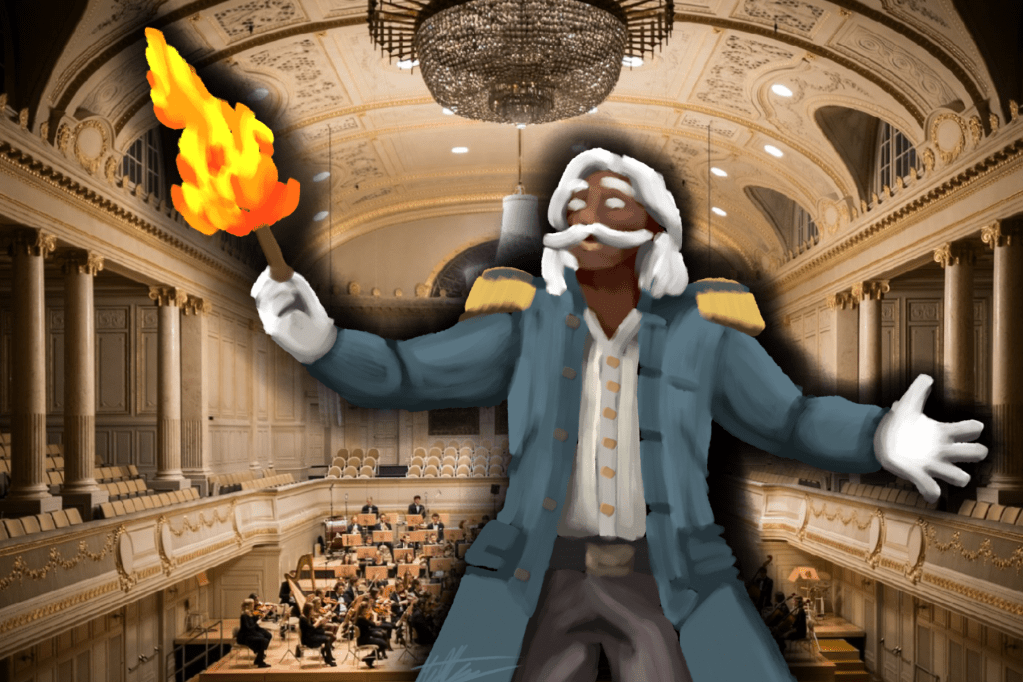
Image credits: Character model created via heroforge.com, digital painting by Matthew Jobson, photo by Manuel Nägeli on unsplash.com
The Preamble
Homebrew is one of my favorite ways to engage with D&D 5e. For the uninitiated, “homebrew” generally refers to any game element that has been designed by a fan of the game, rather than coming from an official publication. This can be basically anything, from custom settings to custom spells, with some people even going so far as to make custom classes for the game. Making homebrew can be a lot of fun, especially when you get to use it or see somebody else use it in game, but it also isn’t always intuitive, especially when you want to create something that could influence game balance. For example, what is the difference between an uncommon magic item and a rare one? What about the difference between a 4th level spell and a 5th level spell?
If you want to dip your toes into homebrew but aren’t quite sure how, or if you just want to learn a little bit more about how a certain subclass works, welcome! This series is designed for you. First, I will take some game element, such as subclasses for a certain class, a specific rarity of magic item, or spells of a certain level, and give an in-depth analysis of the way that game element is designed. Most of the time, this analysis will include a combination of hard and fast rules, patterns to look out for, and general advice about best practices. Then, in my next post, I will take you step-by-step through the process of making your own version of that game element, and give you a free piece of homebrew that you can use in your games as well. Today, I’ll walk you through the process of creating your own Bard subclass, with the College of Symphony.
Also, as a little update, D&D Beyond now refers to the rules introduced in the revised Player’s Handbook, Dungeon Master’s Guide, and Monster Manual as the 5.5e rules. Going forward, if I mention the 5.5 or 5.5e rules, that’s the ruleset I’m talking about.
Getting Started
This post assumes that you’ve already got a good knowledge of the Bard class and existing Bard subclasses. If not, check out Part 1 of this series, where I go more in-depth about both topics.
Choosing a Concept
When designing a subclass, we have to start with a basic concept. For me, this generally comes from a question: “What if you could do _____ in D&D?” When you ask this question, it’s important to consider if your answer has to do more with Aesthetics or Mechanics. A question about Aesthetics relates to the story you’re trying to tell, while a question about Mechanics relates to the way whatever you’re designing will interact with the rest of the game. By the time we’re finished with the subclass, aesthetics and mechanics will need to be intertwined, but we don’t need to start worrying about that quite yet.
Last time, we talked about how a Bard’s subclass highlights a specific element of their performance or performance style; the Creation Bard is boundlessly creative, the Dance Bard is always on the move, and the Lore Bard is a master of storytelling. Incidentally, despite Bards being heavily associated with music, there are no official Bard subclasses that are explicitly related to music. I personally am a huge music lover (probably obvious if you’ve seen the 30+ Spotify playlists on this site’s Resources page), so I thought it would be fun to make a subclass that fills that niche.
The Features
Now it’s time to figure out some actual features. Depending on what you want to do, figuring out mechanics can be easier than figuring out aesthetics. For example, when you’re creating a magic item, you can pillage existing features to create something that’s both powerful and easy to use. In subclass design, it can be trickier, since you’ll usually be making a lot of new features. Bard subclasses get these features at levels 3, 6, and 14.
Before we start on any feature text, I think it will be helpful to make a list of design goals. What should the subclass feel like? This will help us figure out if there are any specific abilities we want to incorporate. I want this subclass to feel like a maestro; a master in the art of music. In order to bring that to life, I’m going to take a lot of inspiration for this from the art of conducting. In accordance with this, I’d like to have at least one feature that has to do with tempo, and at least one feature that has to do with dynamics. I also think this should be a very support-focused subclass, with battlefield control as a secondary goal.
With all of that in mind, let’s get to work on some features.
Creating Features for Level 3
Bard subclasses generally get two or more features at Level 3; possibly to compensate for the fact that they only get subclass features 3 times over the course of the class’s progression. One of these features always interacts with Bardic Inspiration in some way, usually either by giving it additional benefits or by giving you alternative ways to use your Bardic Inspiration dice. There’s generally also at least one other feature here. There are basically two categories: Either a moderately good passive benefit or a powerful active ability that is limited in use.
Right off the bat, I think it’s a good idea to try and fulfill some of our design goals. Let’s start with that secondary feature. If we want this Bard to feel like a conductor, I think they need to be able to use wands to cast spells. Inspired by things like the Wand of Conducting and the Musical Accompaniment spell from Pathfinder 2e, I’d also like them to be able to conjure theme music, and potentially have that theme music help out the party.
Level 3: Master Conductor
You can use a Wand as a Spellcasting Focus for your Bard spells. When you do so, faint music can be heard from the wand.
As a Magic action, you can manifest an orchestral score in a 30-foot Emanation that surrounds you for 10 minutes and is audible to creatures of your choice within that radius. It ends early if you dismiss it (no action required), manifest it again, or have the Incapacitated condition. When you manifest the Emanation, you can choose up to three creatures you can see within the Emanation. Each of the chosen creatures gains Heroic Inspiration.
Once you use this feature to grant Heroic Inspiration, you can’t do so again until you finish a Long Rest.
This feature is pretty strong. The ability to use wands is pretty much a ribbon feature, although it could be handy if you come across a Wand of Fireballs. The more important ability here is that you can grant Heroic Inspiration to a significant portion of your party once per day as an action (best used out of combat). I don’t think this is significantly more powerful than origin feats like Musician and Purple Dragon Rook, but it is a nice boost nonetheless.
Now we have to make a feature that interacts with Bardic Inspiration, and I actually run into a bit of a problem here. We’ve established that one of our design goals is to make a feature that has to do with tempo, and if this is going to be that feature, I’d really like for it to involve initiative rolls in some way. However, the Dance Bard already has a feature called Tandem Footwork that interacts with both initiative and Bardic Inspiration. What should I do?
First of all, there’s nothing wrong with having some similarities between subclasses. After all, the Swords Bard and Valor Bard both get Extra Attack at Level 6. Now, I’m obviously not advocating for plagiarism; don’t take credit for ideas that aren’t yours; but especially if you’re just creating something for use at your own table, you don’t have to worry if your feature is similar to a feature from another subclass. That being said, I don’t feel comfortable with a copy + paste in this case. First of all, I think that would constitute plagiarism. Second of all, Tandem Footwork is a Level 6 feature, but I’m making a feature that should be appropriate for Level 3. And third, I don’t think it would be appropriate for me to promise to walk you through the process of creating your own Bard subclass without creating a unique Bardic Inspiration-based feature for Level 3. So let’s think about how to make our feature unique.
Level 3: Set the Tempo
When you roll Initiative and you don’t have the Incapacitated condition, you can expend a use of your Bardic Inspiration and choose one willing creature that can see or hear you within 30 feet of you. Then, choose one of the following effects:
Adagio. The creature’s Initiative is reduced by one roll of your Bardic Inspiration die, and it has Resistance to every damage type except Force until the start of its next turn.
Allegro. The creature gains a bonus to its Initiative equal to one roll of your Bardic Inspiration die, and its Speed increases by 10 feet until the end of its next turn.
This feature is different from Tandem Footwork in a few key ways. One of these ways is that it only targets one creature. This makes it more appropriate for Level 3 than a party-wide buff to Initiative. Additionally, this gives you the option to either increase or decrease a player’s initiative roll. There are a few niche instances where a player might want to go late in the turn order, but the big benefit of the Adagio option is getting Resistance to all damage (except Force) until the start of your first turn. This extra bit of tankiness could make that option worth it, especially if you’ve already got a low initiative bonus. Meanwhile, it’s never bad to go first in combat, and an extra 10 feet of Speed is always nice to have, making Allegro great for any situation.
Creating a Feature for Level 6
Now we reach Level 6, which is complicated, to say the least. Whatever feature you give a subclass here needs to carry you for a while; possibly to the end of the campaign. In any case, this needs to be something memorable that you can benefit from in nearly every game session moving forward.
There’s no specific template for how subclass features at this level are designed, but I basically see three different categories of features here. You have features that effectively steal something from another class, limited use spell-like abilities, and the outliers; usually features that feel like Bardic Inspiration improvements from Level 3, but with a little bit more oomph. I have a very specific idea in mind for Level 14, so this would be a good time to implement that feature related to dynamics that I mentioned in our design goals. Just like how Set the Tempo had abilities for both a tempo increase and a tempo decrease, I want this feature to have two different abilities: One for a crescendo and one for a diminuendo.
So how should we bring this feature to life? Now, we could do something that modifies our spellcasting, like the Sorcerer’s Metamagic. Instead of spending Sorcery Points, you would have to spend uses of Bardic Inspiration. This kind of feature would as a result fall into two of the three categories I mentioned earlier: Both the features that steal from other classes and the features that give you additional abilities tied to Bardic Inspiration. Something like this:
Level 6: Dynamic Adjustment
You gain the following benefits.
Forte. When you cast a spell that deals damage, you can expend a use of your Bardic Inspiration, roll your Bardic Inspiration die, and gain a bonus equal to the number rolled to one damage roll of the spell.
Piano. When you cast a spell that has a Verbal component, you can expend a use of your Bardic Inspiration to cast the spell without Verbal components.
I like this feature, but I don’t love it here. My big issue is that this feature isn’t really geared towards support or battlefield control, which I mentioned in our design goals. Not only do neither of these abilities support your allies, but they also cost uses of Bardic Inspiration; and I think a support-focused subclass should primarily use Bardic Inspiration for support. I think a feature involving some kind of persistent buff or debuff would make more sense.
Level 6: Crescendo/Diminuendo
You always have the Enlarge/Reduce spell prepared.
As a Magic action, you can cast Enlarge/Reduce without a spell slot. When you do so, the target is subjected to additional effects depending on which effect you chose when you cast the spell.
Enlarge. The target’s voice booms three times as loud as normal. The target’s attacks with its enlarged weapons or Unarmed Strikes deal an extra 1d6 Thunder damage on a hit, instead of the normal damage of the spell.
Reduce. The target can only speak in a whisper. Whenever the target casts a spell with a Verbal component, it must make a Charisma saving throw. On a failed save, the spell fails. If that spell was cast with a spell slot, the slot isn’t expended.
Once you use this feature, you can’t use it again until you finish a Long Rest. You can also restore your use of it by expending a level 3+ spell slot (no action required).
I like this feature a lot more. The best point of comparison for it is probably the Moon Bard’s Blessing of the Moonwells. It feels more in line with the other features so far both thematically and mechanically. I love the control potential of Reduce; I think it could be especially potent as a Legendary Resistance burner. Enlarge feels on the weaker side since it’s only 1 extra damage per hit compared to a standard Enlarge/Reduce spell, but over the course of a combat encounter, it could add up to 9-12 extra points of damage, which is not-terrific-but-respectable; and I also think that if it added a d8 instead of a d6, it would be too strong compared to other abilities at this level.
Creating a Feature for Level 14
Finally, we reach Level 14, the capstone feature of the subclass. These ones, like a lot of subclass capstones, have a lot of variety. We ultimately want something here that ties our subclass together, both thematically and mechanically. We could do this with one or more improvements to low-level features (following the examples set by the Creation, Moon, and Swords Bards), or we could come up with a unique feature that sends us out with a bang in the style of Tchaikovsky’s 1812 Overture. Personally, I’m partial to the latter.
Level 14: Concertmaster’s Rondo
You can inspire your allies to repeat their greatest performances. As a Magic action, you can choose one willing creature within 60 feet of you that can see or hear you and doesn’t have the Incapacitated condition. Immediately after you take this action, your turn ends, and the chosen creature gains Heroic Inspiration. The chosen creature can then immediately take one additional turn.
Once you use this feature, you can’t do so again until you finish a Long Rest.
Yes, this feature was inspired by the Dancer class from the Fire Emblem series. I’ve always wanted to see a Bard subclass that had this kind of feature, and I think it slots in perfectly here. And this kind of ability is really potent. It’s not exactly a “get out of jail free” card, but it definitely has the potential to turn the tide of a combat encounter when you don’t have the right tool for something, but somebody else does. Do you need more damage? Give the Fighter another turn. Need an emergency heal? Use this feature on the party Cleric. Maybe the party decides its time to run with a Teleport spell? Target the Sorcerer or the Wizard. Plus, the target gets Heroic Inspiration in case they fail something crucial; maybe they get a Nat 1 on an important attack roll, or they don’t roll high enough to dispel the enemy’s Foresight spell.
Final Thoughts
Refinement
It may look like we’re done now that we have all our features, but we still have to go back and do some polishing. For starters, if you haven’t already named your subclass, give it a name! Official Bard subclasses are always called the “College of _,” but they’re often colloquially referred to by whatever fills in that blank (for example, the College of Lore is often referred to as simply the Lore Bard). Since our Bard is all about music, I’m going to call it the College of Symphony.
Next, we’ll want to write some flavor text. Flavor text is basically a way to give the subclass built-in story prompts for players or DMs who want to incorporate it into their games. For any Bard subclass, it’s important to explain what your Bard is known for. Here’s an example from the revised Player’s Handbook for why a Bard might join the College of Valor:
“Bards of the College of Valor are daring storytellers whose tales preserve the memory of the great heroes of the past. These Bards sing the deeds of the mighty in vaulted halls or to crowds gathered around great bonfires. They travel to witness great events firsthand and to ensure that the memory of these events doesn’t pass away. With their songs, they inspire new generations to reach the same heights of accomplishment as the heroes of old.”
Once the flavor text is done, all we really have left to do is compile all of our flavor text and features somewhere (assuming we haven’t done so already) so we can share our creation with others. The Homebrewery is a really great resource that I see people use all the time. It can make your homebrew creations look really professional, and is completely free to use! Alternatively, D&D Beyond has a homebrew system that lets you create options that will work with the site’s built-in character sheets. However, there is a learning curve to both. For my homebrew, I tend to use Google Docs. It’s a platform I’m very familiar with already, and it keeps a record of changes I’ve made to a design, so I can easily change things back at any time. But whatever you do, I highly recommend picking a tool and sticking with it. The less time you have to spend learning a new tool, the more time you can spend thinking about your designs.
And now, what you’ve all been waiting for: The (almost) finished product, available below for free! I have also included two versions: One designed for the 2014 rules, and one designed for the 2024 rules.
But wait, what do I mean, “almost finished?” Well, we’ve still got one phase left: Playtesting. As of the writing of this article, I haven’t had the chance to playtest this subclass, and no design is really finished until you’ve gotten a chance to see it in action. All that being said, if you decide to try it out, please feel free to email me at shieldoffaith5e@gmail.com to share your experience and any suggestions you might have about how to make it more fun or any exploits you find that could use rebalancing. I’d love to hear any stories about the kinds of characters this might inspire you to create!
Additional Reading
Want some more guidelines on how to create your own stuff for 5e? Here are some resources you may find helpful!
Unearthed Arcana (Internet Archive)
This is a link to a collection of practically all the Unearthed Arcana documents released for D&D 5e before playtesting began for what would become the 2024 Player’s Handbook compiled on the Internet Archive site. There’s a lot of interesting material in here, but specifically pages 16-20 include notes from Rodney Thompson, one of the lead designers of 5th Edition, on important things to keep in mind when creating class options for each of the 12 core classes in 5e. He doesn’t go super in-depth, but his notes are worth reading, even if the design philosophy for several classes has changed since 2015.
Creating a New D&D Subclass: The Oni Sorcerer (The Obojima Podcast)
This is a podcast episode from The Obojima Podcast where the writers of Obojima: Tales from the Tall Grass design a subclass for the Sorcerer. The episode primarily focuses on the story of their subclass and how it fits into the world of Obojima, but they do still discuss mechanics a good bit in the latter half of the episode. Not only did this help change my opinions about how cool giants could be in D&D, it also provides a window into the creative process of some very talented designers.
Jacob Collier Improvises with Orchestra (Live in San Francisco)
To close things out, I’m actually going to share a video that inspired me while working on this post. As a peek behind the curtain, this College of Symphony subclass has been in my personal catalogue for a while, but when I watched this video, it made me appreciate conducting and composition in a whole new way; so much so that I knew I wanted the subclass for this post to be inspired by those arts. Do yourself a favor and check it out!

Leave a comment