

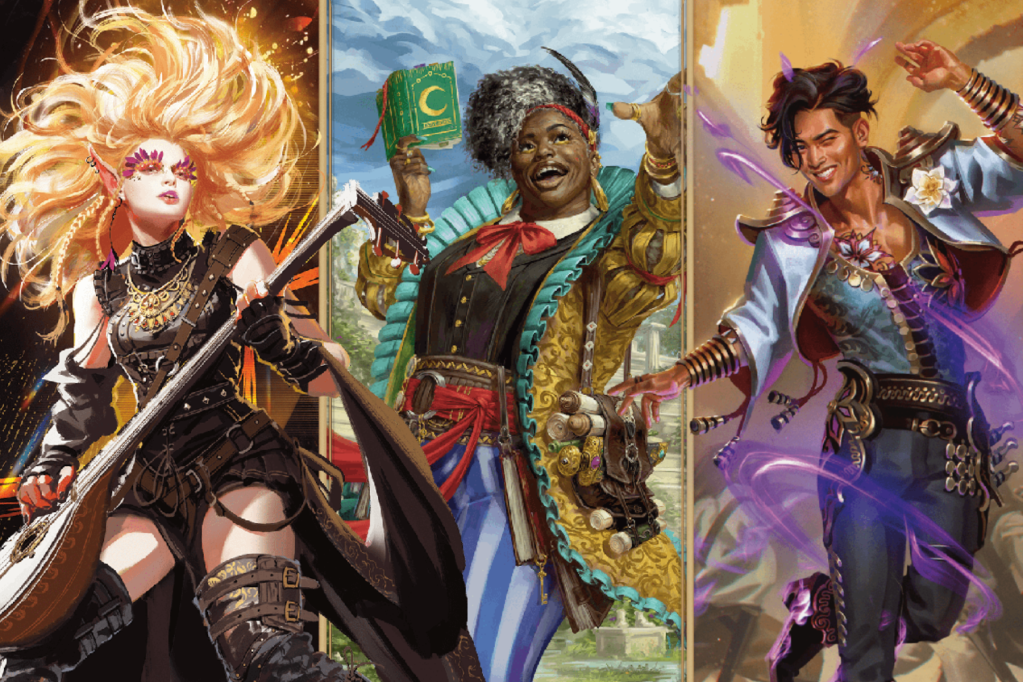
Image credits (left to right): Art by Hocheol Ryu, Mike Pape, and Katerina Ladon
The Preamble
Homebrew is one of my favorite ways to engage with D&D 5e. For the uninitiated, “homebrew” generally refers to any game element that has been designed by a fan of the game, rather than coming from an official publication. This can be basically anything, from custom settings to custom spells, with some people even going so far as to make custom classes for the game. Making homebrew can be a lot of fun, especially when you get to use it or see somebody else use it in game, but it also isn’t always intuitive, especially when you want to create something that could influence game balance. For example, what is the difference between an uncommon magic item and a rare one? What about the difference between a 4th level spell and a 5th level spell?
If you want to dip your toes into homebrew but aren’t quite sure how, or if you just want to learn a little bit more about how a certain subclass works, welcome! This series is designed for you. First, I will take some game element, such as subclasses for a certain class, a specific rarity of magic item, or spells of a certain level, and give an in-depth analysis of the way that game element is designed. Most of the time, this analysis will include a combination of hard and fast rules, patterns to look out for, and general advice about best practices. Then, in my next post, I will take you step-by-step through the process of making your own version of that game element, and give you a free piece of homebrew that you can use in your games as well. Today, we’re going to be looking at a class very close to my heart, since it was the first class I ever played: The Bard.
Also, as a little update, D&D Beyond now refers to the rules introduced in the revised Player’s Handbook, Dungeon Master’s Guide, and Monster Manual as the 5.5e rules. Going forward, if I mention the 5.5 or 5.5e rules, that’s the ruleset I’m talking about.
Getting Started
Understanding the Class
Understanding how a class functions is crucial to understanding how to make a subclass for that class. This will not only help you know existing strengths and weaknesses of the class that your subclass may want to enhance or counter, it can also help you avoid redundant or conflicting features. For example, Barbarians get Advantage on initiative rolls at Level 7, so any subclass feature that gives advantage on initiative rolls would eventually be rendered worthless. All that being said, let’s run through a quick refresher in case you’re not super familiar with the Bard.
Bards are one of the most versatile classes in D&D. They get some of the best skill-based features in the game with flexible starting proficiencies, Jack of All Trades, and Expertise. As a full spellcaster, they also get a spell list full of fantastic options for healing, battlefield control, and out-of-combat utility; and at higher levels, they get access to nearly every spell in the game thanks to Magical Secrets. Not to mention their most iconic feature, Bardic Inspiration, which is terrific support both in and out of combat. They generally struggle for pure damage, but aside from that, there’s very little they can’t do.
Bards rely on Charisma as their primary ability score, usually followed by either Dexterity or Constitution. Their Hit Point Die is 1d8 per Bard Level, and they get proficiency in Dexterity and Charisma saving throws. They are proficient with Simple Weapons, and have Armor Training with Light Armor. Finally, and most important for our purposes, Bards get subclass features at Level 3, Level 6, and Level 14.
Choosing a Concept
However, before we get into a bigger discussion of mechanics, we should take a second to talk about aesthetics: What kind of story does the class tell? By default, many people assume that a Bard is some kind of musician, but nowadays, it is largely accepted that art of any kind, not just music, is what defines a Bard. Poetry, dance, dramatic acting, and illustration are all perfectly acceptable arts to lean into. You could even play a Bard as a mime, although that could be tough to pull off in a role-playing game where you’re usually expected to speak.
Importantly, though, there isn’t necessarily a correlation between the type of art that a Bard focuses on and that Bard’s subclass. Instead, Bardic subclasses, also called Bardic Colleges, are defined by a Bard’s artistic instincts, and perhaps to an extent, their reputation. For example, the College of Glamour Bard creates art that is driven by spectacle, while the College of Dance Bard makes art characterized by movement. But a Bard from either subclass could be a musician/vocalist, a dancer, or something else entirely; perhaps they do some kind of performance art. In other words, you can think of a subclass not as a treatise on the kind of art a Bard makes, but instead a record of how that Bard or their art will be remembered.
The Analysis
Class Features up to Level 3
Before we look at any Level 3 Bard subclass features, here is a list of all the features that Bards have access to by the time they get their first subclass feature(s). This is important to know in case one or more of these features is referenced in a subclass feature. If you haven’t played a Bard before, you may want to have a Player’s Handbook nearby to cross-reference the specifics of what each feature does, because I am simplifying some for the sake of brevity.
Bardic Inspiration. The most iconic feature for Bards before Level 10. This feature gives you a pool of dice (called Bardic Inspiration dice) that you can give to allies as a Bonus Action, and they can later expend to boost failed D20 tests. The die starts as a d6, and increases every five levels or so. You get a number of these dice equal to your Charisma modifier (probably 3 or 4 at this level), and you regain all expended dice when you finish a Long Rest.
Spellcasting. You gain spell slots at the same rate of progression as any other full spellcaster. You can prepare your spells from the Bard spell list, and Charisma is your spellcasting ability for your Bard spells. Notably, you can only change your prepared spells when you level up, unlike some other spellcasters (e.g. Clerics, Wizards) who can change them every Long Rest. By the time you reach Level 3 and get your first subclass features, you will have access to 1st and 2nd level spells and spell slots. You also get 2 Cantrips.
Expertise. You can add double your Proficiency Bonus to any ability check that uses your proficiency in two skills with which you are already proficient. We’ll revisit this feature and pick two more proficiencies at Level 9.
Jack of All Trades. Meanwhile, you can add half your Proficiency Bonus rounded down to all those ability checks that you’re not proficient in (the bonus is +1 at this level, which increases to +2 at Level 9 and +3 at Level 17). Unlike the 2014 rules, the 5.5 PHB explicitly states that this only includes ability checks that involve a skill proficiency, so you can’t add this bonus to your Initiative rolls anymore.
Bard Subclasses at Level 3
Bard subclasses generally get two or more features at Level 3; possibly to compensate for the fact that they only get subclass features 3 times over the course of the class’s progression. One of these features always interacts with Bardic Inspiration in some way, either by giving it additional benefits (like the Valor Bard’s Combat Inspiration or the Creation Bard’s Mote of Inspiration) or by giving you alternative ways to use your Bardic Inspiration dice (like the Moon Bard’s Moon’s Inspiration or the Eloquence Bard’s Unsettling Words). The College of Dance is the exception here, since none of the abilities granted by its Dazzling Footwork feature fall neatly into either category. However, two benefits from that feature (Agile Strikes and Bardic Damage) are still directly tied to Bardic Inspiration in one way or another.
But like I mentioned earlier, there’s generally at least one other feature here. There are basically two categories here: Either a moderately good passive benefit or a powerful active ability that is limited in use. The Colleges of Lore, Swords, and Valor all get passive benefits in the form of extra proficiencies (the Swords Bard also gets a Fighting Style here), while the Eloquence Bard gets the notorious Silver Tongue, which makes it nigh impossible for them to fail a typical Deception or Persuasion check. Meanwhile, examples of powerful, active abilities that are limited in use are the Glamour Bard’s Beguiling Magic and the Creation Bard’s Performance of Creation. These features can generally be used once for free per Long Rest, and thereafter require some resource expenditure to activate again (the Glamour Bard needs to spend Bardic Inspiration, while the Creation Bard needs to spend a Level 2+ spell slot).
Class Features up to Level 6
Bards get a few class features between Level 3 and Level 6 that are important to be aware of, so I’ll give an overview of those before we continue.
Ability Score Improvement. Gives you a chance to increase one of your ability scores (usually Charisma at this level), either increasing it by 2 with the Ability Score Improvement feat or increasing it by 1 with a different feat of your choice. Some common feats to grab at this level are Fey Touched and War Caster. For Bards and other primary spellcasters, War Caster is particularly noteworthy, because it’s generally considered a “must-have” feat; in other words, a lot of characters will pick it up right at Level 4. This means that past this point, you likely don’t want any features that will be redundant with these feats. For example, since War Caster gives Advantage on Constitution saving throws to maintain Concentration, you probably don’t want to make a Level 6 or Level 14 feature that does the same thing, because there’s no point in having that feature twice; unless the idea is that your subclass will negate the need for that feat. In the case of must-have feats like War Caster, though, you should definitely give that feature at Level 6; very few spellcasters want to wait until Level 14 to get Advantage on their Concentration checks.
Font of Inspiration. You now regain all expended uses of your Bardic Inspiration when you finish a Short Rest, in addition to regaining them after a Long Rest. Plus, new to 5.5, you can now spend a spell slot of any level to regain an expended Bardic Inspiration if you have none left.
Bardic Inspiration. Speaking of Bardic Inspiration, your Bardic Inspiration Die increases from 1d6 to 1d8. Not a new feature, but noteworthy nonetheless.
Spellcasting. Also by no means a new feature, but by this level, you have access to spells of up to 3rd level from the Bard spell list. You also get an extra Cantrip.
Now let’s revisit our subclasses and see what they give us at this level:
Bard Subclasses at Level 6
Now we reach Level 6, which is complicated, to say the least. Whatever feature you give a subclass here needs to carry you for a while; possibly to the end of the campaign. In any case, this needs to be something memorable that you can benefit from in nearly every game session moving forward.
There’s no specific template for how subclass features at this level are designed, but I basically see three different categories of features here. To kick things off, you have features that effectively steal something from another class. The Lore Bard and Spirits Bard get this in the form of Magical Discoveries and Spirit Session respectively, while the Swords and Valor Bards both get Extra Attack. Extra Attack is obviously pillaged from your standard Martial class at Level 5, while Magical Discoveries and Spirit Session are low-level proxies for Magical Secrets.
Next, we have limited use spell-like abilities: Things like the Creation Bard’s Animating Performance and the Glamour Bard’s Mantle of Majesty. These features have long durations (lasting for at least one full combat encounter under ideal circumstances) and are usually geared towards control or support. In terms of power level, they’re about on par with decent (not necessarily phenomenal) 3rd level spells; Beacon of Hope and Major Image come to mind as good points of comparison. I would also place the Moon Bard’s Blessing of Moonlight, the Whispers Bard’s Mantle of Whispers, and the Eloquence Bard’s Universal Speech in this category, although only one of those is strong enough to carry a subclass at this level in my opinion (sorry, College of Whispers).
Finally, we have the outliers. These features feel a lot like those Level 3 Bardic Inspiration improvements, but with (potentially) a little bit more oomph. First up is the Eloquence Bard’s Unfailing Inspiration, which basically guarantees that your Bardic Inspiration dice (when used as Bardic Inspiration dice) will eventually turn a roll into a success. Next we have the Dance Bard’s Inspiring Movement, which lets you take a Reaction to make an Unarmed Strike and then reposition yourself and an ally at the cost of a Bardic Inspiration die. Lastly, the Dance Bard also gets Tandem Footwork, which lets you expend a Bardic Inspiration die when Initiative is rolled to let yourself and your allies add that die to your Initiative rolls.
Class Features up to Level 14
This isn’t the longest gap between subclass features, but it’s close. While we’re waiting to level up 8 more times, let’s review the class features we’ll get during that time:
Countercharm. This feature is so much better in 5.5 than it was in 5e. When a nearby ally fails a saving throw against the Charmed or Frightened condition, you can take a Reaction to let them reroll that save with Advantage. Super handy when it comes up.
Ability Score Improvement. You get two more feats of your choice before Level 14: One at Level 8, and the other at Level 12.
Expertise. You get Expertise in two more skills. Neat.
Magical Secrets. You can now learn spells from the Cleric, Druid, and Wizard spell lists (in addition to the Bard spell list) whenever you pick up new spells. This includes whenever you replace an old spell with a new one as a result of leveling up.
Bardic Inspiration. Your Bardic Inspiration die increases to a d10.
Spellcasting. By this level, you also have access to spells of up to 7th level, and you get one more Cantrip.
Bard Subclasses at Level 14
Finally, we reach Level 14, the capstone feature of the subclass. These ones, like a lot of subclass capstones, have a lot of variety. In fact, this is probably going to become a pattern as we look at the rest of the classes; the higher level you get, the less consistent the kinds of features you get are (with the Paladin as the primary exception, specifically because of their Level 20 features).
The Lore Bard’s Peerless Skill enables them to improve their own ability checks and attack rolls with Bardic Inspiration, while the Eloquence Bard’s Infectious Inspiration effectively gets 5 extra uses of the feature for their allies. The Dance Bard steals the Evasion feature and makes it better. The Valor Bard can make a weapon attack as a Bonus Action after casting a spell with their Action. The Whispers Bard gets a disappointing once per day ability. When in doubt, you can simply improve one or more previous features, as seen with the College of Creation, College of the Moon, and College of Swords subclasses.
Class Features Beyond Level 14
This round of features will be a little different than the others. Even though we don’t have any subclass features left to cover, I think it’s worth noting the features we get after Level 14. Knowing these features can be helpful for understanding any subtle improvements our subclass features may get beyond Level 14, and they can also be helpful when we start building our own subclasses so we know what’s on the horizon.
Ability Score Improvement. You get one more general feat, and one Epic Boon feat.
Superior Inspiration. When you roll initiative, you regain expended uses of Bardic Inspiration until you have two.
Bardic Inspiration. Your Bardic Inspiration die maxes out as a d12.
Spellcasting. You get access to spells of up to 9th level.
Words of Creation. You always have the Power Word Heal and Power Word Kill spells prepared (both 9th level spells), and when you cast either one, you can target two creatures instead of one if both intended targets are within 10 feet of each other.
Final Thoughts
There are a couple of things I want to address with some final thoughts. First of all, let’s review what we’ve learned. Bards get subclass features at Levels 3, 6, and 14. There are some pretty clear patterns to follow at Level 3, but Levels 6 and 14 are far more diverse. In my opinion, the most important feature that all Bard subclasses get is some kind of feature that revolves around Bardic Inspiration: Every official Bard subclass gets this kind of feature (and most unofficial ones I’ve seen get it too).
Making a fun subclass for Bards could be easier than making one for other classes, because you don’t need a lot of features to make a good Bard subclass. On the flipside, there’s also more pressure for each level to grant something meaningful; poorly thought out features stand out more when you get less goodies to compensate for them; one of the reasons why I was harsh on the Whispers Bard. Ultimately, you probably need to put just as much time and thought into your Bard subclasses as you do any other subclass.
Finally, I want to emphasize that Bard subclasses aren’t just meant to tell you what kind of performance your character specializes in. You can include elements of that (see the College of Dance), but you don’t want to be too restrictive. Within the College of Dance, for instance, there can be ballerinas, acrobats, flamenco dancers, and musical theatre ensemble members. Like all subclasses, you have to strike a good balance; your concept needs to be specific enough to inspire unique character concepts, but broad enough that there can be some variety within those concepts.
All that being said, I hope you found a part of this helpful. And if you still don’t feel ready to create your own Bard subclass, stay tuned, because in my next post, I’ll go even more in-depth as I walk you through the process from start to finish. I hope you’ll join me, if for no other reason than to get a cool subclass to use at your table. See you there!

Leave a comment