

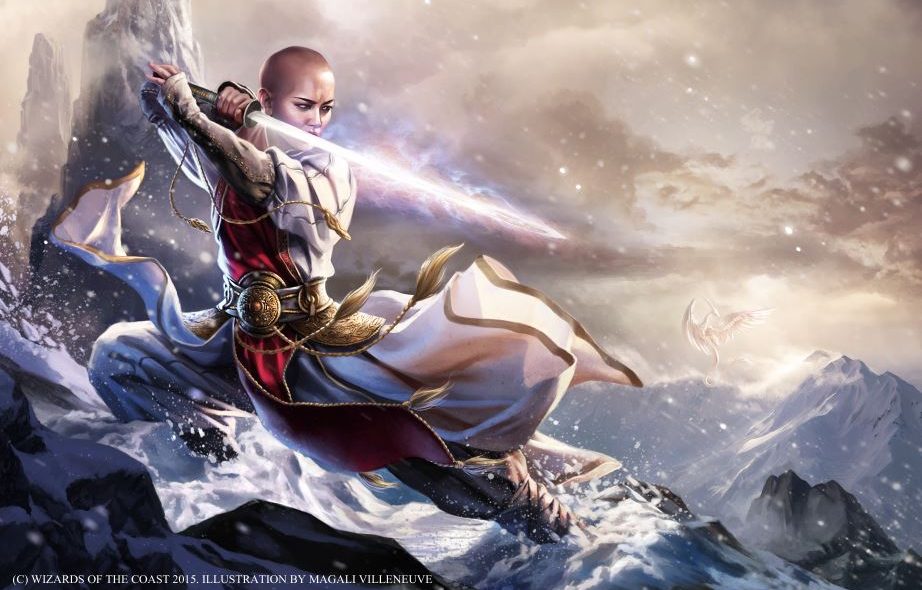
Image credits: Art by Magali Villeneuve
The Preamble
Homebrew is great. I love making homebrew: Magic items, spells, subclasses, even full classes sometimes. Not only can it be really rewarding creatively, but it can also introduce some really fun variety into your games. Not to mention that players love subclasses that were basically made just for them. But admittedly, making a whole subclass (or especially an entire class) is a lot of work. And it can be tough to set aside time to work on something like that when you’re also studying for classes, working a job, supporting a family, and/or dealing with life in general.
But fear not! Because homebrew doesn’t always have to be a huge endeavor. There are plenty of ways to homebrew that take just five minutes, but can be just as impactful as the ones that take hours, days, or weeks. Hence the term “microbrewing:” The same amount of flavor, but at a fraction of the scale. Today, I’m going to talk about how to customize classes with some optional class features.
Classes are the most exciting and defining part of a character in D&D. A character’s background and species may tell you where that character comes from, but a class tells you where that character is and, to some extent, where they are going. From a mechanics perspective, your class also has the biggest impact on your playstyle by a very wide margin. Sure, a Fighter and a Barbarian can be built in very similar ways, but you can’t deny that the average Druid will have a vastly different playstyle than the average Rogue.
Subclasses can do a lot of heavy lifting to distinguish different members of a single class from each other. Bards of the College of Valor or College of Swords will experience a very different style of combat from Bards of the College of Glamour or College of Lore. The Eldritch Knight Fighter is clearly distinct from the Cavalier subclass. But subclasses alone can’t change the core identity of a class.
Playing a Jedi
Let’s say you’ve just gotten into Star Wars, and you want to play a jedi. Specifically, you want to play a jedi as presented in the prequels; an unarmored, agile warrior who can leap huge distances, move with blinding speed, and fall from great heights without injury, among other things. Based on that description, the closest you’re going to get is a Monk. Heck, you might even find a cool subclass that gives you telekinetic powers so you can tap into the force and move things with your mind.
But there’s a pretty big issue. Monks punch things. Jedi don’t.
(Except Mace Windu that one time, but I’m not sure if that’s even canon anymore.)
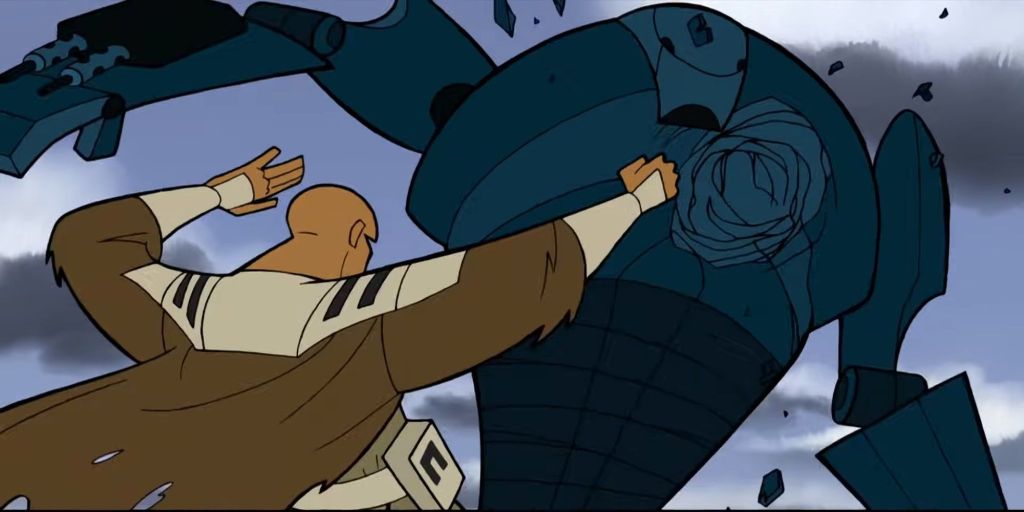
What’s the big deal? Can’t you just play a Monk who doesn’t punch things? Well… yes and no. Yes, you don’t have to use features like Martial Arts or Flurry of Blows, but you’re seriously sandbagging yourself by doing so. Monks already struggle to keep up with other classes for damage past Level 4, and if you take away the Unarmed Strikes they can make as a Bonus Action, then they quickly fall to the bottom of the pack.
So what’s the solution to this issue? Some people might say you should just deal with it. “Either play the class as intended, or don’t play it at all.” That’s a very dismissive way of putting it. So maybe instead they would suggest that you multiclass; get what you want out of Monk, and then take the rest of your levels in Fighter (with the Psi Warrior subclass) or maybe Wizard (with the Bladesinger subclass) to fill in the gaps. That could come together nicely eventually, but it could be a long time before you get there, and you’ll still end up with several features that feel off-theme.
Some people might just say “flavor is free” and tell you to describe your Unarmed Strikes as attacks with your weapon. That’s nice in theory, but it’s really clunky. At the very least, it’ll set off alarm bells in your DM’s head:
Player: “I’m going to run up to the bad guy and make three attacks with my sword!”
DM: “Wait, you’re level 2, how are you making three attacks?”
Player: “One with my action, two with Flurry of Blows.”
DM: “But Flurry of Blows only lets you make unarmed strikes…”
Player: “Well, yeah, but I’m just flavoring it as attacks with my sword.”
DM: “Oh… Okay, sure, that’s fine.” All traces of this discussion are subsequently wiped from the DM’s memory when the Bard makes a mailbox with Minor Illusion and then gets upset that none of the cultists wasted their turns checking the mail.
Not to mention how confusing things can get if your weapon of choice has any special properties. Got a +1 weapon as a magic item? Now you have a different bonus to your weapon attacks and your unarmed strikes, but you have to still call them the same thing for flavor purposes; I’m pretty good at remembering the rules, and I know I’d definitely mix that up a lot. Or maybe you decided to take the Weapon Master feat, and now you have access to the Vex property… But again, only for your weapon attacks, and not for your “weapon attacks.” Confusing.
Some people might say you just need a good subclass. I would also take issue with that for a few reasons, not least among them being the fact that Monks don’t get subclasses until Level 3. But let’s assume that your campaign starts at or above Level 3 (as many do), or you don’t mind waiting a few levels to play the character you wanted to play. Even then, the subclass route will cause issues. If Martial Arts and Flurry of Blows aren’t factored into the power budget of the subclass, then the subclass will likely become overpowered if you decide to start using those features later on. And if the subclass places a ban on the use of those features, then it’ll have to compensate with a few features of its own, at which point there’s so much going on just at Level 3 that you’re overwhelmed.
So if none of these is the solution, what is?
Optional Class Features
Optional class features were first introduced to 5e in Tasha’s Cauldron of Everything. This book contains optional class features for all 12 Player’s Handbook classes. Most of these features were add-ons; you get them in addition to the base class features. However, there were a few cases where these features replaced something from the base class (in fact, there were five cases, and all but one of them was for a Ranger feature). But that’s just a history lesson. What we’re interested in is making our own optional class features.
Why is this better than any of the solutions I pitched earlier? Well if we really do have issues with these low-level features, then this is our best option aside from making a whole new class. In fact, that’s kind of what we’re doing; we’re making a variant of an existing class. This also means we won’t have nearly as much confusion: No features on our character sheet that we won’t be using, and way less reflavoring of abilities.
The Process
Making an optional class feature is simple: Take the class feature(s) that you don’t like for whatever reason and just make some adjustments. Now, a quick disclaimer: For the purposes of these changes, even though I want these optional class features to make the Monk feel a little bit more like a jedi, I don’t want to lean into that too much, for two main reasons:
- I want these changes to be accessible to any setting. A Monk that specializes in weapon use rather than Unarmed Strikes is very easy to slot into any setting, but if you make “the Force” (or whatever you’d want to call it) a core part of that character, before even introducing a subclass, then it becomes way more intimidating. Plus, I’d like the theming here to be flexible. Sure, you could go all-in on the jedi flavor, but you could also just want to play a weapon-forward Monk for other reasons. Telekinesis could make these revisions more interesting to some players, but it might turn others away.
- I want to keep these changes relatively simple. After all, the whole point of these “microbrewing” posts is to show you how to make impactful homebrew at a small scale. Introducing the Force would add several additional layers of complexity that I don’t think are necessary. Plus, we have to consider how this will interact with subclasses. If we make the Force a core part of these changes, then existing subclasses (such as the Warrior of the Elements subclass) may feel thematically off-key. Besides, if you still want to play with the Force, plenty of people online have created their own psionic subclasses that you can use.
Now that we’re clear on that, let’s jump into the changes that I’m making.
Level 1: Core Monk Traits and Martial Arts
Right off the bat, there’s something in the Core Monk Traits that I’d like to address. If we’re going to focus on weapon use, then we should have proficiency in all the weapons that it would make sense for us to use. I don’t think Heavy weapons make sense, but pretty much every other Martial weapon should be fine. In accordance with this change, I also want to change the starting equipment to include an appropriate Martial weapon.
Next, let’s look at Martial Arts. There are two problems for us here. First of all, this restricts us to only using Simple melee weapons or Martial melee weapons with the Light property, so we have to expand this to make those new weapon proficiencies we added mean anything. The other issue here is the Bonus Unarmed Strike, because it doesn’t synergize with our new focus on weapons. Right now, this is basically just as good as an extra weapon attack as a Bonus Action each turn, so I don’t think it’s a huge deal if we replace this with a weapon attack. Finally, it might be nice to add a Weapon Mastery or two here, since we’re not using Unarmed Strikes anymore.
At this point, we’ve basically just provided buffs to the base Monk. Nothing we’ve granted so far is really overpowered, but I think it’s still fair to give some drawbacks. An easy thing to axe here is anything that has to do with Unarmed Strikes; a desire to avoid unarmed combat is the reason we’re making these revisions anyways. Also, instead of letting any weapon that you’re proficient with be a Monk weapon, I’m going to restrict you to just picking two qualifying weapons. This way, you go from a versatile brawler to a highly-specialized weapon user.
Thankfully, that’s all we have to worry about at Level 1, so let’s jump ahead to Level 2.
Level 2: Monk’s Focus
Surprisingly, the only issue with this feature is Flurry of Blows, since that still relies on Unarmed Strikes. This change could be as simple as just replacing the Unarmed Strikes with weapon attacks using a Monk weapon, but I think that might be too simple. In general, attacking with Unarmed Strikes is weaker than attacking with a weapon, especially because this version of the Monk now has access to Weapon Mastery, and there are generally more options to increase weapon damage than there are to increase the damage of Unarmed Strikes. So in order to keep this feature in check, it will only allow you to add your ability modifier to the damage of one of these attacks.
With that, we’re in the clear for features we need to change until Level 6.
Level 6: Empowered Strikes
This feature only has an effect if you’re using Unarmed Strikes. Once again, there’s a very simple option we could go for where we just let this work for Monk weapons instead of Unarmed Strikes, and honestly, that would be great. But since we’re so weapon-forward with this character, I think it would be nice if we could get a Fighting Style at some point. So for this optional feature, I’m going to allow the option to pick between a Fighting Style feat or dealing Force damage with your weapon attacks, sort of like how the Paladin and Ranger get unique alternatives to Fighting Styles at Level 2.
Now we only have one more level to address.
Level 10: Heightened Focus
Just like with the original Monk’s Focus, our only issue here is Flurry of Blows. No point in drawing this out: We’re doing the same thing here that we did at Level 2.
Finishing Touches
If you haven’t already, you should compile these changes so they’re easy to reference. For each optional class feature, give it a unique name, and clearly denote which Monk feature it replaces. This will make it easy for other people (players and DMs) to read and understand your homebrew.
Next, if you want, you can come up with an alternative name for the class when played using your variant features. We could just call this version of the Monk the “Jedi,” but again, we didn’t really interact with the Force at all, and that could also break immersion if you’re not in a Star Wars setting. Instead, I’m going to call it the Blade Priest, as a variation on Sword Saint (the literal translation of the word “Kensei”).
Finally, when you present these optional rules to your table, you may also want to write down how you’ll address any issues that arise within subclasses. You can simply write an explanation (for example, “any feature that involves Unarmed Strikes will be adjusted to instead involve Monk weapons”), or you can write optional versions of those features to go along with the rest of your changes.
On that note, here’s a link to a page that includes all the optional class features you need to play a Blade Priest, as well as optional features for each Monk subclass in the revised Player’s Handbook. Each document only contains the optional rules; you use the base version of any feature not covered.
Final Thoughts
The optional class features that you make don’t have to be quite this involved. Maybe Warlocks in your setting can get power by studying dark beings, rather than communing with them. In this case, you could allow an optional rule for Warlocks to use Intelligence as their primary ability, rather than Charisma. Or maybe you’re running an evil campaign, and one of your players wants to play a Paladin. Perhaps then you could create an optional class feature that changes the Radiant damage of their Divine Smite and Radiant Strikes to Necrotic damage.
Now, to be clear, the purpose of this approach is not necessarily to change anything regarding game balance: Especially if you’re new to 5e. A lot of players and DMs assume that certain classes are overpowered because of something they read online, or because they just don’t have a great grasp of the rules yet. For example, plenty of people think the Rogue is overpowered when they first learn about Sneak Attack, because it’s a lot of dice, but in reality, Rogue is one of the weakest classes in the game for pure damage.
I hope a part of this has inspired you: Maybe you want to go make your own optional class features, or maybe you want to use the Blade Priest rules in your next campaign. In any case, if you were inspired by something in this article, please shoot me an email at shieldoffaith5e@gmail.com! I’d love to hear about it.

Leave a comment