

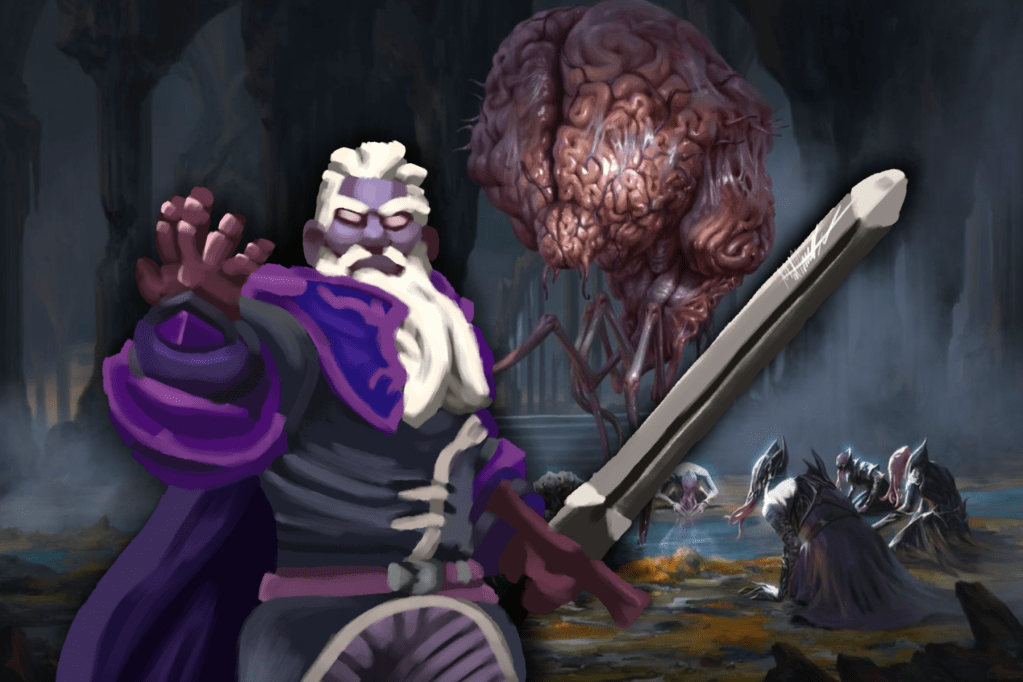
Image credits: Character model created via heroforge.com, digital painting by Matthew Jobson, MTG art by Daarken
The Preamble
Homebrew is one of my favorite ways to engage with D&D 5e. For the uninitiated, “homebrew” generally refers to any game element that has been designed by a fan of the game, rather than coming from an official publication. This can be basically anything, from custom settings to custom spells, with some people even going so far as to make custom classes for the game. Making homebrew can be a lot of fun, especially when you get to use it or see somebody else use it in game, but it also isn’t always intuitive, especially when you want to create something that could influence game balance. For example, what is the difference between an uncommon magic item and a rare one? What about the difference between a 4th level spell and a 5th level spell?
If you want to dip your toes into homebrew but aren’t quite sure how, or if you just want to learn a little bit more about how a certain subclass works, welcome! This series is designed for you. First, I will take some game element, such as subclasses for a certain class, a specific rarity of magic item, or spells of a certain level, and give an in-depth analysis of the way that game element is designed. Most of the time, this analysis will include a combination of hard and fast rules, patterns to look out for, and general advice about best practices. Then, in my next post, I will take you step-by-step through the process of making your own version of that game element, and give you a free piece of homebrew that you can use in your games as well. Today, I’ll walk you through the process of creating your own Paladin subclass, with the Oath of Subjugation.
Getting Started
This post assumes that you’ve already got a good knowledge of the Paladin class and existing Paladin subclasses. If not, check out Part 1 of this series, where I go more in-depth about both topics.
Choosing a Concept
When designing a subclass, we have to start with a basic concept. For me, this generally comes from a question: “What if you could do _____ in D&D?” When you ask this question, it’s important to consider if your answer has to do more with Aesthetics or Mechanics. A question about Aesthetics relates to the story you’re trying to tell, while a question about Mechanics relates to the way whatever you’re designing will interact with the rest of the game. By the time we’re finished with the subclass, aesthetics and mechanics will need to be intertwined, but we don’t need to start worrying about that quite yet.
Just like last time, this subclass was inspired by an aesthetic question. The idea actually came to me while I was polishing up my Circle of the Weird Druid subclass. I started to think what a Paladin powered by the far realm might look like, sort of the antithesis to the Oath of the Watchers. Perhaps they were almost turned into a mind flayer, but were released because they swore to bring back even more suitable candidates. Maybe they were even implanted with a mind flayer tadpole as insurance, set to begin ceremorphosis the minute the oath was broken. The idea of a Sacred Oath that was also something of a curse was really exciting to me, so I got to work on mapping out the subclass in my head.
The Features
Now it’s time to figure out some actual features. Depending on what you want to do, figuring out mechanics can be easier than figuring out aesthetics. For example, when you’re creating a magic item, you can pillage existing features to create something that’s both powerful and easy to use. In subclass design, it can be trickier, since you’ll usually be making a lot of new features. Paladin subclasses get these features at levels 3, 7, 15, and 20.
Before we start on any feature text, I think it will be helpful to make a list of design goals. What should the subclass feel like? This will help us figure out if there are any specific abilities we want to incorporate. One thing that’s really great about building a subclass based off a D&D monster is that there’s a lot of inspiration at your fingertips for different mechanics you may want to incorporate. To help me develop these design goals, I looked at the stat blocks for all sorts of illithids and related entities: Mind flayers, elder brains, intellect devourers, and more.
After some research, these are the design goals that I landed on:
- In a very broad sense, I want this subclass to feel like a mind flayer. This may sound obvious, but it will be a guiding principle for us, so it’s important to mention.
- Mind flayers and associated creatures are big on grappling enemies with their tentacles. They really just want you to hold still so they can eat your brain. For this reason, I think it is important to make this subclass effective as a grappler.
- The Mind Blast ability that mind flayers have access to is iconic. I want this subclass to have a similar ability.
- Most of these creatures also have some form of telepathy. I want this subclass to be capable of telepathy as well.
- In illithid culture, any spellcasting that isn’t psionic is considered deviant. I want this subclass to make you feel like a psionic spellcaster.
- Finally, on a more general flavor note, I want the subclass to emphasize the idea that maybe your character has lost some of their humanity by taking this path.
With all of that in mind (no pun intended), let’s get to work on some features.
Creating Features for Level 3
Paladin subclasses follow a very strict formula at Level 3. All Paladin subclasses get a list of always-prepared Oath Spells. This list usually contains two spells each of 1st-5th level, and traditionally, several options that aren’t already on the Paladin spell list. Going back to our design goals, we want this subclass to feel like a psionic spellcaster. To achieve this, I want to include spells that are either telepathic or telekinetic in some way. Then, to round out the list, I’ll add on some spells that mind flayers and associated creatures can cast. Here’s a sample of what our spell list could look like with just this approach:
Oath of Subjugation Spells
| Paladin Level | Spells |
| 3 | Dissonant Whispers, Feather Fall |
| 5 | Detect Thoughts, Levitate |
| 9 | Lightning Bolt, Sending |
| 13 | Confusion, Evard’s Black Tentacles |
| 17 | Dominate Person, Wall of Force |
I really like this list so far. It has a little bit of everything: Damage, battlefield control, and utility. However, even though it follows all the “rules” of Oath Spells lists, it feels like it’s missing something. For one, I’d like to include Mage Hand for a little bit of low-level telepathy, even though Oath Spells lists don’t usually include cantrips. Lucky for us, the Oath of the Noble Genies subclass from Forgotten Realms: Heroes of Faerun has the Elementalism cantrip on its spell list, so even though it’s unusual, we wouldn’t be breaking any rules by adding it. But even then, there’s another ability I’m going to include on the final version of this feature.
Level 3: Oath of Subjugation Spells
The magic of your oath ensures you always have certain spells ready; when you reach a Paladin level specified in the Oath of Subjugation Spells table, you thereafter always have the listed spells prepared.
| Paladin Level | Spells |
| 3 | Dissonant Whispers, Feather Fall, Mage Hand |
| 5 | Detect Thoughts, Levitate |
| 9 | Lightning Bolt, Sending |
| 13 | Confusion, Evard’s Black Tentacles |
| 17 | Dominate Person, Wall of Force |
Whenever you cast a spell granted by this feature, it requires no Verbal or Material components.
Let’s discuss that last line. It may seem insignificant, because it’s ultimately just a ribbon feature, but Paladin subclasses don’t usually get ribbon features at all. However, since this generally won’t affect gameplay, I think the design goal of making the spellcasting granted by the subclass feel psionic outweighs the design convention of Paladins not getting ribbon features.
All Paladin subclasses at this level also get one or two features that are fueled by Channel Divinity. The specifics of these features vary: Some of these features, like Nature’s Wrath from the Oath of the Ancients, require an action economy cost (such as a Magic action) to activate, while others, like the Oath of Devotion’s Sacred Weapon, can be triggered as part of another action, like the Attack action.
Let’s revisit our design goals. There are three items on the list that we could use Channel Divinity to accomplish: A grapple ability, a “mind blast” of some kind, and a form of telepathy. We can only pick two of the three. I want to talk about grappling first. Grappling can kind of define a character’s playstyle. If you want a character to be a grappler, they need to get tools for that at low levels, or else they might spend a significant portion of the campaign focusing on a different playstyle (remember, plenty of campaigns end before Level 10).
That leaves us with two options. To decide which one we want here, I think it’s good to look ahead. At Level 7, Paladins usually get some kind of aura. A mind blast doesn’t really fit into that mold, so if we don’t use it here, then we’ll have to wait until Level 15 to grant that kind of feature. Telepathy, on the other hand, feels very appropriate for an aura. So I think a mind blast is the winner here.
Level 3: Grasp of Subjugation
When you take the Attack action on your turn, you can replace one of the attacks and expend a use of your Channel Divinity to make a melee spell attack against a creature within 5 feet. On a hit, the target takes Psychic damage equal to 2d8 + your Charisma modifier. Additionally, if you have at least one hand free and the target is no more than two sizes larger than you, the target is Grappled (the escape DC equals your Spell Save DC).
Whenever a creature grappled in this way makes a Constitution saving throw to maintain Concentration, the minimum DC equals your Spell Save DC.
Level 3: Mental Shockwave
As a Magic action, you can expend a use of your Channel Divinity to emit a wave of Psychic Energy in a 30-foot cone. Each creature within that area must succeed on an Intelligence saving throw or take Psychic damage equal to half your Paladin level (round up) and be Stunned until the end of your next turn, or until it takes any damage (not including the damage from this feature).
Let’s talk about how these features help accomplish our design goals. Obviously Grasp of Subjugation makes us better at grappling, but if that was all it did, then it might feel a little bland. In order to cement it as a “mind flayer” feature, we add on a little bit of Psychic damage, and the grappled target suffers a secondary effect that implies some sort of mental impairment. These effects also elevate the feature above a standard grapple with an Unarmed Strike, making it worth a use of your Channel Divinity.
Meanwhile, Mental Shockwave is basically a level-appropriate version of the Mind Blast ability we wanted to replicate. This one was tough to balance, because I felt it was crucial to the feel of the subclass for this feature to both deal Psychic damage and also stun enemies, but the Stunned condition is more potent than conditions applied by other Channel Divinity options at this level, and very few Channel Divinity options deal damage directly.
To keep this in line with other options at this level, there were two tactics I used. First, I applied a limitation to the Stunned condition, which is that it ends early if the target takes damage other than Psychic damage. This is a big caveat for some of the ways you might exploit this feature; for example, if you cast Fireball on all the stunned targets since they’ll automatically fail their Dexterity save against the spell, then you’re also ending the condition on all of those targets. Meanwhile, the damage is pretty insignificant, but it still feels good because it scales consistently. This is a good tactic if you need a feature to deal damage to achieve a design goal, but you don’t want it to get out of hand.
Creating a Feature for Level 7
The vast majority of Paladin subclasses at this level give you some kind of boost to your Aura of Protection. The Oath of Devotion makes it so that creatures of your choice in your Aura of Protection can no longer be Charmed, while the Oath of the Watchers gives you and your allies a bonus to Initiative rolls while within the Aura.
As I mentioned earlier, this is where I want to add a telepathy feature. But the radius of your Aura of Protection at this level is still very small (a 10-foot Emanation), so just letting you speak telepathically with creatures in that area doesn’t seem like enough. There’s also an argument to be made that telepathy on its own isn’t interesting enough for a subclass feature at Level 7. Now that we’ve thought through those concerns, we can make sure this feature addresses both.
Level 7: Aura of the Hive Mind
You have Telepathy out to a range of 60 feet, and creatures of your choice within your Aura of Protection also gain this benefit.
Additionally, you can overhear any telepathic communication that occurs between a creature within your Aura of Protection and any other creature. A creature protected by a Nondetection spell or similar magic can’t be overheard in this manner.
This way, the telepathy is still tied to your Aura of Protection, but it actually has a decent range, in case you want to communicate with your allies from across the battlefield. You may also notice that I’ve once again worked a ribbon feature into the text of a standard subclass feature. This is one of my favorite ways to make subclasses feel unique. The ability to overhear telepathic communication was in this case inspired by the elder brain stat block; specifically, a regional effect from its lair called “Telepathic Eavesdropping.” Remember, inspiration for your own homebrew can be found anywhere; even in places you might not expect, like Lair Actions or Regional Effects.
Creating a Feature for Level 15
This is the first level for Paladin subclasses where there’s not a clear template for what to do. Because there’s so much variety here, I think you can ultimately do whatever you want here, so long as it’s thematically resonant and appropriately powerful for Level 15.
By this level, we’ve achieved most of our design goals in one way or another. This means this level can be used to upgrade a mechanic from earlier in our character’s career, much like how the Soul of Vengeance feature from the Oath of Vengeance grants an upgrade to Vow of Enmity. I also think that by this point, the subclass should lean a lot further into the idea that you are losing your humanity by following this path. Trigger warning for cranial trauma.
Level 15: Extract Brain
As a Bonus Action while you are grappling a creature, you can expend a spell slot and make a melee spell attack against that creature. On a hit, the target takes 1d10 plus your Charisma modifier Piercing damage, plus 1d10 additional Piercing damage per level of the spell slot expended. If this damage reduces the target to 0 Hit Points, you kill the target by devouring its brain.
I’m almost worried I crossed a line with this one, but I figure if you’ve made it this far, you probably think mind flayers are cool enough to be on board for something like this. Mechanically, this is basically a powerful alternative to Divine Smite while your Grasp of Subjugation (or any other grapple) is active. From a numbers perspective, this also does more damage than Divine Smite on average, especially if you have the Grappler feat or some other way to get Advantage on the grappled target.
Meanwhile, the level of horror in this feature helps drive home the tragedy of the subclass. You swore this oath to avoid becoming a mind flayer, but this feature makes it clear that you’re not really human (or whatever species) anymore; perhaps it would have been better if you had just accepted ceremorphosis or enslavement. This could also be a tipping point in a character’s arc; perhaps they realize that they need to find a way out, even if it costs them everything.
Paladin Subclasses at Level 20
Almost all Paladin subclass features at Level 20 give you a temporary transformation that you can activate once per day, potentially more if you want to expend a 5th level spell slot. The exact duration of each transformation varies, but 10 minutes seems to be the current standard. For this subclass, I think it was inevitable that this feature would basically turn you into a mind flayer.
Level 20: Ceremorphic Crescendo
As a Bonus Action, you gain the benefits below until you end them (no action required). If you do not end these benefits within 10 minutes of activating this feature, they become permanent, and you irreversibly transform into an illithid version of yourself under the DM’s control. Once you use this feature, you can’t use it again until you finish a Long Rest. You can also restore your use of it by expending a level 5 spell slot (no action required).
Mental Domination. Once on each of your turns, you can force one creature within your Aura of Protection to succeed on a Wisdom saving throw or take Psychic damage equal to twice your Charisma modifier and have the Prone condition.
Psionic Propulsion. You gain a Flying speed of 60 feet and can hover.
Telepathic Awareness. You have Blindsight out to a range of 60 feet.
In terms of our design goals, this feature really loops back to the idea of psionics. None of the abilities here are particularly noteworthy; Mental Domination is the most unique feature here, and it’s basically just a twist on the Frightful Aura ability that the Oath of Vengeance Paladin gets from its Avenging Angel feature.
Ultimately, the big thing that this feature has that separates it from other Paladin capstones is the way the duration works. This is yet another way to work flavor into a feature without changing its power level. It’s very unlikely that a character will ever run up against this time limit on accident. So instead of serving as a potential “gotcha” moment for the DM, this is a storytelling device: You’ve been serving the mind flayer colony for so long, you’re doing all sorts of things that mind flayers do; at this point, why not just take the final step, and let the hive mind consume you?
Final Thoughts
Refinement
It may look like we’re done now that we have all our features, but we still have to go back and do some polishing. For starters, if you haven’t already named your subclass, give it a name! Official Paladin subclasses are always (with the exception of Oathbreaker) called the “Oath of _____,” but they’re often colloquially referred to by whatever fills in that blank (for example, the Oath of the Ancients is often referred to as simply the Ancients Paladin). Since our Paladin is all about collecting slaves for the mind flayer colony, we’re calling it the Oath of Subjugation.
Next, we’ll want to write some flavor text. Flavor text is basically a way to give the subclass built-in story prompts for players or DMs who want to incorporate it into their games. For any Paladin subclass, it’s important to explain what might drive a Paladin to swear their divine oath. Here’s an example from the revised Player’s Handbook for why a Paladin might swear the Oath of Devotion:
“These Paladins… hold themselves to the highest standards of conduct, and some—for better or worse—hold the rest of the world to the same standards. Many who swear this oath are devoted to gods of law and good and use their gods’ tenets as the measure of personal devotion.”
Another super important part of this flavor text for Paladin subclasses is a list of tenets. Here’s an example of tenets from the Oath of Glory Paladin:
- Endeavor to be known by your deeds.
- Face hardships with courage.
- Inspire others to strive for glory.
Once the flavor text is done, all we really have left to do is compile all of our flavor text and features somewhere (assuming we haven’t done so already) so we can share our creation with others. The Homebrewery is a really great resource that I see people use all the time. It can make your homebrew creations look really professional, and is completely free to use! Alternatively, D&D Beyond has a homebrew system that lets you create options that will work with the site’s built-in character sheets. However, there is a learning curve to both. For my homebrew, I tend to use Google Docs. It’s a platform I’m very familiar with already, and it keeps a record of changes I’ve made to a design, so I can easily change things back at any time. But whatever you do, I highly recommend picking a tool and sticking with it. The less time you have to spend learning a new tool, the more time you can spend thinking about your designs.
And now, what you’ve all been waiting for: The (almost) finished product, available below for free! I have also included two versions: One designed for the 2014 rules, and one designed for the 2024 rules.
But wait, what do I mean, “almost finished?” Well, we’ve still got one phase left: Playtesting. As of the writing of this article, I haven’t had the chance to playtest this subclass, and no design is really finished until you’ve gotten a chance to see it in action. All that being said, if you decide to try it out, please feel free to email me at shieldoffaith5e@gmail.com to share your experience and any suggestions you might have about how to make it more fun or any exploits you find that could use rebalancing. I’d love to hear any stories about the kinds of characters this might inspire you to create!
Additional Reading
Want some more guidelines on how to create your own stuff for 5e? Here are some resources you may find helpful!
Unearthed Arcana (Internet Archive)
This is a link to a collection of practically all the Unearthed Arcana documents released for D&D 5e before playtesting began for what would become the 2024 Player’s Handbook compiled on the Internet Archive site. There’s a lot of interesting material in here, but specifically pages 16-20 include notes from Rodney Thompson, one of the lead designers of 5th Edition, on important things to keep in mind when creating class options for each of the 12 core classes in 5e. He doesn’t go super in-depth, but his notes are worth reading, even if the design philosophy for several classes has changed since 2015.
Creating a New D&D Subclass: The Oni Sorcerer (The Obojima Podcast)
This is a podcast episode from The Obojima Podcast where the writers of Obojima: Tales from the Tall Grass design a subclass for the Sorcerer. The episode primarily focuses on the story of their subclass and how it fits into the world of Obojima, but they do still discuss mechanics a good bit in the latter half of the episode. Not only did this help change my opinions about how cool giants could be in D&D, it also provides a window into the creative process of some very talented designers.

Leave a comment