

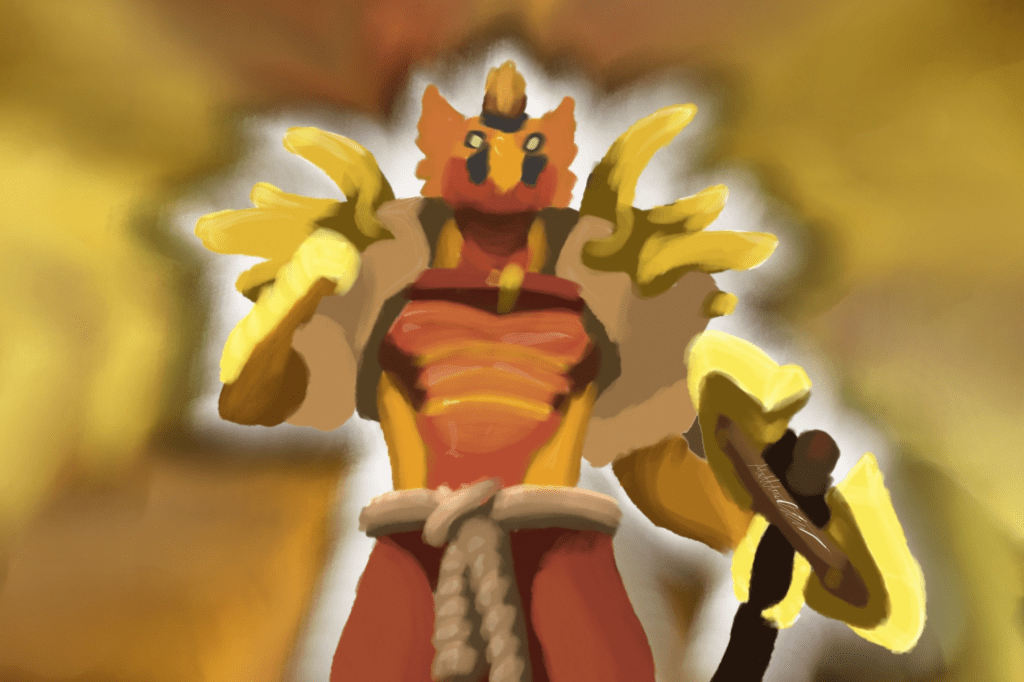
Image credits: Character model created via heroforge.com, digital painting by Matthew Jobson
The Preamble
Homebrew is one of my favorite ways to engage with D&D 5e. For the uninitiated, “homebrew” generally refers to any game element that has been designed by a fan of the game, rather than coming from an official publication. This can be basically anything, from custom settings to custom spells, with some people even going so far as to make custom classes for the game. Making homebrew can be a lot of fun, especially when you get to use it or see somebody else use it in game, but it also isn’t always intuitive, especially when you want to create something that could influence game balance. For example, what is the difference between an uncommon magic item and a rare one? What about the difference between a 4th level spell and a 5th level spell?
If you want to dip your toes into homebrew but aren’t quite sure how, or if you just want to learn a little bit more about how a certain subclass works, welcome! This series is designed for you. First, I will take some game element, such as subclasses for a certain class, a specific rarity of magic item, or spells of a certain level, and give an in-depth analysis of the way that game element is designed. Most of the time, this analysis will include a combination of hard and fast rules, patterns to look out for, and general advice about best practices. Then, in my next post, I will take you step-by-step through the process of making your own version of that game element, and give you a free piece of homebrew that you can use in your games as well. Today, I’ll walk you through the process of creating your own Barbarian subclass, with the Path of the Rising Sun.
Getting Started
This post assumes that you’ve already got a good knowledge of the Barbarian class and existing Barbarian subclasses. If not, check out Part 1 of this series, where I go more in-depth about both topics.
Choosing a Concept
When designing a subclass, we have to start with a basic concept. For me, this generally comes from a question: “What if you could do _____ in D&D?” When you ask this question, it’s important to consider if your answer has to do more with Aesthetics or Mechanics. A question about Aesthetics relates to the story you’re trying to tell, while a question about Mechanics relates to the way whatever you’re designing will interact with the rest of the game. By the time we’re finished with the subclass, aesthetics and mechanics will need to be intertwined, but we don’t need to start worrying about that quite yet.
For this subclass, I started with an aesthetic question. I initially began work on it when the Spelljammer books for 5e were being previewed, and I was trying to create a subclass for every class in the game that would make sense for a sci-fi setting. So my question became, “What if there was a Barbarian subclass that fit into a Sci-Fi setting in D&D?”
When you start a design with an aesthetic question, there are a few follow up questions to ask yourself. For starters, “why can’t I do _____ in D&D with the rules that are available?” A motto of many D&D players is that “Flavor is Free.” Why go through all the effort of creating a brand new subclass if we can just tell the same story with existing material? To answer this question, you have to – you guessed it – look at the existing material. Once you’ve got a good knowledge base for what’s out there, you can figure out how to make your design unique.
A lot of the Barbarian’s Primal Paths can actually be translated to a sci-fi setting fairly seamlessly. The Path of the Ancestral Guardian lets you protect your allies with the aid of ancestral spirits, but you could just as easily be using some kind of projected psychic ward or forcefield generator for that purpose. The Path of the Beast mutates you into different animals thanks to its ancestry or a fey blessing, but in a sci-fi world, you could be the subject of human experimentation, or you could use some kind of Ben-10-esque Omnitrix to transform into different alien creatures. And there’s no reason why a Barbarian from the Path of the Berserker can’t be a genetically-enhanced super soldier, or a Zealot can’t follow a sci-fi religion like the Arbiter from the Halo series. When doing this exercise, it can also be helpful to look at other classes and their subclasses. For example, we could create a warrior in a heavy suit of power armor, but you can already replicate that fantasy using the Armorer Artificer.
After looking through the existing subclasses and consulting my mind palace for sci-fi imagery that made sense for a Barbarian, I started thinking about what exists in space that is powerful, angry, and doesn’t overlap heavily with any existing material for Barbarians. One iconic image from sci-fi that came to mind was the binary sunset from Star Wars: A New Hope. And that got me thinking: Twin suns, stars, all sorts of celestial bodies play a role in different sci-fi worlds. What if there was a Barbarian that tapped into that power?
The Features
Now that I had a basic aesthetic idea locked in, I was able to start thinking about the mechanics. Depending on what you want to do, figuring out mechanics can be easier than figuring out aesthetics. For example, when you’re creating a magic item, you can pillage existing features to create something that’s both powerful and easy to use. In subclass design, it can be a little bit trickier, since you’ll be making a lot of new features. Thankfully for our Barbarian, we have a pretty good template for what those features should do.
Barbarians get subclass features at levels 3, 6, 10, and 14. Most subclasses get only one feature at each of these levels, and any additional features are usually ribbons; features that are flavorful, but not particularly powerful. An example of a ribbon feature is the Path of the Wild Heart’s Animal Speaker feature.
Creating a Feature for Level 3
There is one feature that all Barbarian subclasses get at Level 3: A feature that augments their Rage. This feature not only makes the Barbarian more mechanically powerful in some way, but also defines a specific playstyle. Since our subclass taps into the power of the stars, we should consider how that would augment its Rage. We could have a feature that deals extra Fire or Radiant damage when you hit an enemy during your Rage, but that could step on the toes of the Path of the Zealot’s Level 3 feature, since that also deals radiant damage. Plus, plenty of Barbarians are already damage specialists. Maybe instead, we can give our Barbarian a feature that leans more into utility and control.
Level 3: Beacon of the Brightest Star
When you enter a Rage, you can emit Bright Light in a 20-foot radius that originates from you and Dim Light 20 feet beyond that. This aura ends when your Rage ends. You can also activate it or deactivate it on subsequent turns as a Bonus Action.
Once per turn when you hit a creature within the bright light created by your Rage with an attack, you can force that creature to succeed on a Constitution saving throw or be Blinded until the start of your next turn.
The DC for this saving throw is equal to 8 + your Constitution modifier and Proficiency Bonus. The effect ends early if your Rage ends, if your aura is deactivated, or if the creature starts its turn more than 20 feet away from you.
Level 3: Touch of Sunlight
You know the Light cantrip. Constitution is your spellcasting ability for this spell.
Let’s go in order. Beacon of the Brightest Star has a few things going for it that separate you from other Barbarians. First of all, you get the ability to light up dark areas with your Rage. This gives you a clear aesthetic with a visual transformation tied to your Rage that is unique from any other subclass, although you still have the option to turn off the lights when you need to be subtle. In terms of numerical power, the blinded condition is very potent, since it gives you and your allies Advantage on your attacks against the creature, and gives the creature Disadvantage on its attacks against you. In terms of mechanical power, this is almost a combination of the Path of the Ancestral Guardian’s Ancestral Protectors and the Path of the Wild Heart’s Wolf augmentation from Rage of the Wilds. In order to keep this in check, we restrict it to being used once per turn, and it can be resisted with a successful Constitution saving throw. Meanwhile, Touch of Sunlight is a ribbon feature that gives you the ability to light up dark areas even when you aren’t in a Rage.
As a designer, my biggest point of concern for this level is the duration of the blinded condition. I went back and forth for a while on how long the condition should last, but I ultimately decided that it should end at the start of your turn for a few reasons. First of all, thanks to Reckless Attack, the base class already has a built-in way to get advantage at the cost of some survivability, so you don’t need a feature like this to get Advantage. Additionally, using Reckless Attack combined with this feature helps you direct hits towards yourself, because even though it makes you harder to hit, you are still the most appealing target. These are all things to keep in mind once the subclass is ready for playtesting and refinement, but for now, I’m satisfied with where we’re at, so we’ll move on to Level 6.
Creating a Feature for Level 6
Primal Path features at Level 6 usually give some benefit to your defenses or utility. This level is also super important for emphasizing any design themes you want to put forward with your subclass. About half of the features at this level are still dependent on your Rage, and features that don’t rely on your Rage are more likely to be passive.
I think some kind of Darkvision at this level would be great thematically. However, I also want this subclass to eventually get some features that involve Radiant damage, and this level is super important for establishing themes of a subclass moving forward. As a result, I’ve put together the following feature:
Level 6: Sun’s Blessings
You gain the following benefits:
Eyes of the Dawn. You can see normally in darkness, including the darkness created by the Darkness spell, to a distance of 100 feet.
Sunlight Strikes. When you hit a creature with a weapon or Unarmed Strike while your Rage is active, you can choose to deal Radiant damage instead of the attack’s normal damage type.
This feature is basically two features in one. Eyes of the Dawn is a unique version of darkvision that is normally only available to Warlocks who take the Devil’s Sight invocation. However, this feature might actually not come up that often, especially since we can create Bright Light whenever we enter a Rage. For this reason, I think the extra benefit of Sunlight Strikes here is a perfectly fine addition. While flat-out immunity to regular weapon attacks is less common since the release of the 2024 Monster Manual, there are still benefits to swapping damage types occasionally. It’s also a flavorful feature, and it will set us up for some of our higher-level benefits. Additionally, depending on your feat choices (for example, if you are using Crusher, Piercer, or Slasher), you may not take advantage of this benefit that often either.
Creating a Feature for Level 10
Features granted at Level 10 are not particularly consistent. However, in general, each feature at this level is strongly tied into the theme of the subclass; something that makes sense from a flavor perspective, but could have caused balance issues before this level. They also help define the subclass playstyle even further.
At this level, the bonuses that enemies have to their Constitution saving throws are getting higher than ever, and it might be rare that we manage to blind anything. A feature that can help us circumvent those high saving throws would be nice, especially if it can also increase our capacity for support in other ways.
Level 10: Solar Flare
When a creature within 20 feet of you succeeds on an attack roll or saving throw while your Rage is active, you can take a Reaction to subtract 1d6 from the roll. If this changes the roll from a success to a failure, the creature takes Radiant damage equal to the number rolled on the d6 + your Rage Damage bonus.
You can use this feature a number of times equal to your Constitution modifier. You regain all expended uses when you finish a Long Rest.
This feature builds upon the support abilities that the subclass gained at Level 3 by granting additional ways to shut down an enemy’s effectiveness. Now, in addition to potentially being blinded and having disadvantage on attacks, the enemy also has to deal with a numerical penalty to some of its attacks or saving throws. This feature is at its most potent when being used to ensure a particular spell or effect sticks to the enemy, or to help burn an enemy’s Legendary Resistances. However, this feature could prove to be too potent in certain party compositions. As a result, we should keep a close eye on this feature during playtesting, and see if it needs to be reined in. If it does turn out to be overpowered, we could potentially make it usable only once per active Rage, or we could reduce the d6 to a d4.
Creating a Feature for Level 14
Finally, we reach Level 14, the capstone feature of the subclass. These are similar to Level 10 features in that the specifics of each feature vary, but they should usually be the most powerful feature that the subclass gets access to. A feature at this level should be memorable and potent, and if possible, it’s also great if it can tie the whole subclass together in some way. At this point, I want to do a little bit more with our aura of sunlight that we create, and I want to add a little bit more damage to the subclass. The damage bump from Solar Flare is pretty inconsequential, and damage features are usually pretty fun as well.
Level 14: Blaze of Glory
Your attacks and effects that deal Radiant damage ignore Resistance to radiant damage. Additionally, at the start of each of your turns while your Rage is active, you can deal radiant damage to each creature of your choice within 20 feet of you equal to 1d6 + your Rage Damage bonus.
The damage bump from this feature is nothing to sneeze at. Dealing an average of 6.5 damage at this level to all enemies within 20 feet of you with no action economy cost is more potent than you might expect, especially since those enemies can’t resist it unless they are fully immune to Radiant damage. Moreover, unlike a similar feature granted by the Path of the Storm Herald at low levels, there’s no risk of friendly-fire, since you get to choose which creatures are affected. However, although it is a lot of damage, it’s not necessarily more impressive than any other subclass. The Path of the Berserker and Path of the Zealot at this level get an extra 10.5 damage on a hit once per turn, and the Path of the Giant deals an extra 7 damage on every attack that hits. This feature can potentially deal more overall damage, because it applies to multiple targets, but multi-target damage isn’t usually as helpful as single-target damage.
This feature also provides an improvement to the Level 6 and Level 10 features by making our damage harder to ignore. Lastly, this feature is meant to tie the subclass together around the idea of this aura of sunlight that you create with your Rage. Your Level 3, Level 10, and Level 14 features all have a unified range of 20 feet, which not only makes it easy to keep track of what effects apply to which creatures, but also gives the subclass a theme that ties into both aesthetics and mechanics.
Final Thoughts
Refinement
It may look like we’re done now that we have all our features, but we still have to go back and do some polishing. For starters, if you haven’t already named your subclass, give it a name! Official Barbarian subclasses are always called the “Path of the _____,” but they’re often colloquially referred to by whatever fills in that blank (for example, the Path of the Giant is often referred to as simply the Giant Barbarian). Since our Barbarian is all about the sun, we’re calling it the Path of the Rising Sun. Next, we’ll want to write some flavor text. Flavor text is basically a way to give the subclass built-in story prompts for players or DMs who want to incorporate it into their games. Here’s an example of flavor text from the description of the Path of the Berserker from the 2024 Player’s Handbook:
“Barbarians who walk the Path of the Berserker direct their Rage primarily toward violence. Their path is one of untrammeled fury, and they thrill in the chaos of battle as they allow their Rage to seize and empower them.”
You may have noticed that as we’ve developed this subclass, we’ve kind of lost any focus on sci-fi or twin suns or anything like that. And that’s okay! Your mental image of a subclass doesn’t have to stay the same from start to finish, so long as you keep the features and flavor text consistent. Personally, I like the fact that this subclass is more attuned to the sun than the cosmos at large, partially because it makes the subclass more setting agnostic: After all pretty much every setting has a sun, and a lot of real-world cultures are centered around the sun.
Once the flavor text is done, all we really have left to do is compile all of our flavor text and features somewhere (assuming we haven’t done so already) so we can share our creation with others. The Homebrewery is a really great resource that I see people use all the time. It can make your homebrew creations look really professional, and is completely free to use! Alternatively, D&D Beyond has a homebrew system that lets you create options that will work with the site’s built-in character sheets. However, there is a learning curve to both. For my homebrew, I tend to use Google Docs. It’s a platform I’m very familiar with already, and it keeps a record of changes I’ve made to a design, so I can easily change things back at any time. But whatever you do, I highly recommend picking a tool and sticking with it. The less time you have to spend learning a new tool, the more time you can spend thinking about your designs.
And now, what you’ve all been waiting for: The (almost) finished product, available below for free! I have also included two versions: One designed for the 2014 rules, and one designed for the 2024 rules.
But wait, what do I mean, “almost finished?” Well, we’ve still got one phase left: Playtesting. As of the writing of this article, I haven’t had the chance to playtest this subclass, and no design is really finished until you’ve gotten a chance to see it in action. All that being said, if you decide to try it out, please feel free to email me at shieldoffaith5e@gmail.com to share your experience and any suggestions you might have about how to make it more fun or any exploits you find that could use rebalancing. I’d love to hear any stories about the kinds of characters this might inspire you to create!
Additional Reading
Want some more guidelines on how to create your own stuff for 5e? Here are some resources you may find helpful!
Unearthed Arcana (Internet Archive)
This is a link to a collection of practically all the Unearthed Arcana documents released for D&D 5e before playtesting began for what would become the 2024 Player’s Handbook compiled on the Internet Archive site. There’s a lot of interesting material in here, but specifically pages 16-20 include notes from Rodney Thompson, one of the lead designers of 5th Edition, on important things to keep in mind when creating class options for each of the 12 core classes in 5e. He doesn’t go super in-depth, but his notes are worth reading, even if the design philosophy for several classes has changed since 2015.
Creating a New D&D Subclass: The Oni Sorcerer (The Obojima Podcast)
This is a podcast episode from The Obojima Podcast where the writers of Obojima: Tales from the Tall Grass design a subclass for the Sorcerer. The episode primarily focuses on the story of their subclass and how it fits into the world of Obojima, but they do still discuss mechanics a good bit in the latter half of the episode. Not only did this help change my opinions about how cool giants could be in D&D, it also provides a window into the creative process of some very talented designers.

Leave a comment