

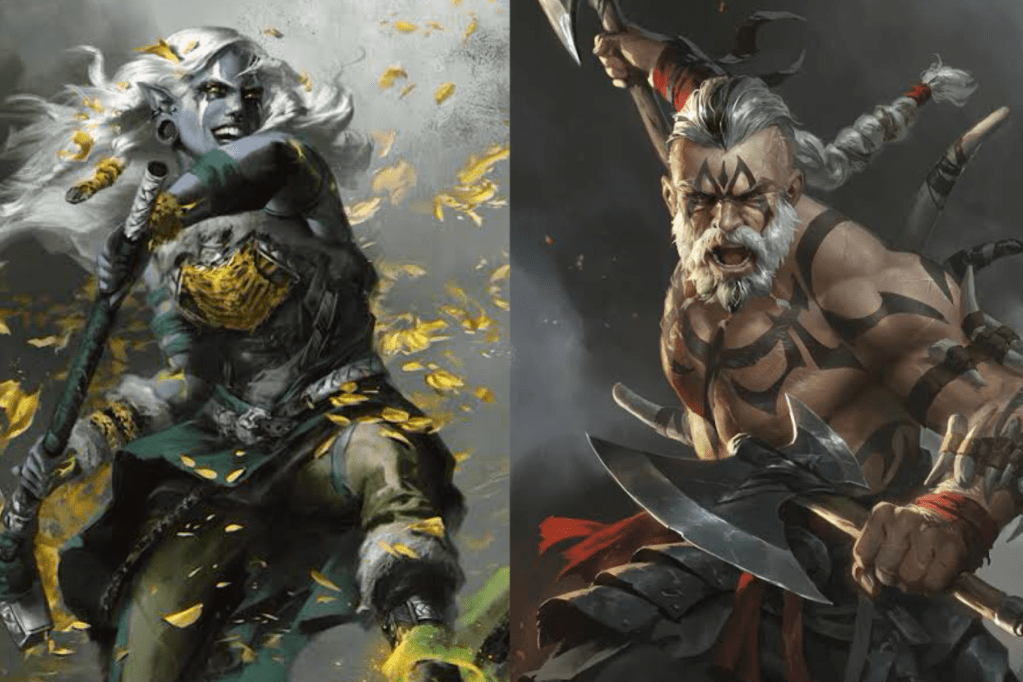
Image credits (left to right): Art by Marcela Medeiros, Nathaniel Himawan
The Preamble
Homebrew is one of my favorite ways to engage with D&D 5e. For the uninitiated, “homebrew” generally refers to any game element that has been designed by a fan of the game, rather than coming from an official publication. This can be basically anything, from custom settings to custom spells, with some people even going so far as to make custom classes for the game. Making homebrew can be a lot of fun, especially when you get to use it or see somebody else use it in game, but it also isn’t always intuitive, especially when you want to create something that could influence game balance. For example, what is the difference between an uncommon magic item and a rare one? What about the difference between a 4th level spell and a 5th level spell?
If you want to dip your toes into homebrew but aren’t quite sure how, or if you just want to learn a little bit more about how a certain subclass works, welcome! This series is designed for you. First, I will take some game element, such as subclasses for a certain class, a specific rarity of magic item, or spells of a certain level, and give an in-depth analysis of the way that game element is designed. Most of the time, this analysis will include a combination of hard and fast rules, patterns to look out for, and general advice about best practices. Then, in my next post, I will take you step-by-step through the process of making your own version of that game element, and give you a free piece of homebrew that you can use in your games as well. For the first installment in this series, we’re going to be looking at how to design a subclass for one of the simplest classes in the game: The Barbarian.
Getting Started
Understanding the Class
Understanding how a class functions is crucial to understanding how to make a subclass for that class. This will not only help you know existing strengths and weaknesses of the class that your subclass may want to enhance or counter, it can also help you avoid redundant or conflicting features. For example, Barbarians get Advantage on initiative rolls at Level 7, so any subclass feature that gives advantage on initiative rolls would eventually be rendered worthless. All that being said, let’s run through a quick refresher in case you’re not super familiar with the Barbarian.
Barbarians are martial (non-spellcasting) characters that serve as effective damage dealers and damage soaks, also often referred to as “tanks.” A lot of their power comes from their Rage mechanic, which gives them a small boost to damage and resistance to some of the most common damage types in the game. In addition to damage and survivability, they also get features to improve their mobility, initiative rolls, and, at higher levels, in-combat utility. However, they cannot cast or concentrate on spells or wear heavy armor while they are raging, and they do not get many features for out-of-combat utility.
Barbarians rely on Strength as their primary ability score, usually followed by Constitution and then either Dexterity or Wisdom. Their Hit Point Die is 1d12 per Barbarian Level, and they get proficiency in Strength and Constitution saving throws. They are proficient with Simple and Martial Weapons, and have Armor Training with Light Armor, Medium Armor, and Shields. Finally, and arguably most important for our purposes, Barbarians get subclass features at Level 3, Level 6, Level 10, and Level 14.
Choosing a Concept
However, before we get into a bigger discussion of mechanics, we should take a second to talk about aesthetics: What kind of story does the class tell? Speaking broadly, a Barbarian is a character who is fueled by supernatural anger and primal power. The subclasses, however, put a little bit more definition on top of that rage. Sure, the Path of the Berserker definitely screams “anger management issues,” but anger management issues don’t give you the ability to smite your enemies with the power of the gods, like the Path of the Zealot can. Meanwhile, the Path of the Ancestral Guardian can summon spirits of their ancestors, and the Path of the World Tree can conjure supernatural roots to bind their enemies.
These subclasses provide story opportunities beyond just anger. In fact, if you really think about it, there’s nothing that says a Barbarian’s Rage has to be represented by them getting angry. For some Barbarians, Rage could be closer to a form of meditation, a supernatural burst of adrenaline, or even a prayer. It could also be tied to some sort of magical curse or blessing (think the Path of the Beast or the Path of Wild Magic).
The Analysis
Class Features up to Level 3
Before we look at any Level 3 Barbarian subclass features, here is a list of all the features that Barbarians have access to by the time they get their first subclass feature(s). This is important to know in case one or more of these features is referenced in a subclass feature. If you haven’t played a Barbarian before, you may want to have a Player’s Handbook nearby to cross-reference the specifics of what each feature does, because I am simplifying some for the sake of brevity.
Rage. The most defining feature of a Barbarian. Lasts for up to 10 minutes if maintained properly, and used primarily in combat. Also grants a bonus to Strength-based weapon attacks (called your Rage Damage Bonus) that increases a few times at higher levels.
Unarmored Defense. Grants you a decent Armor Class if you choose to wade into battle with no armor.
Weapon Mastery. Allows you to use the mastery property of two kinds of melee weapons. It is important to note that this feature does not allow you to use the mastery property of any Ranged weapons, although you can use the mastery property of a Melee weapon with the Thrown property.
Danger Sense. Grants you Advantage on Dexterity saving throws unless you have the Incapacitated condition.
Reckless Attack. Perhaps the true standout feature of the Barbarian class; gives you on-demand Advantage on Strength-based attack rolls at the cost of giving enemies Advantage on attack rolls against you.
Primal Knowledge. Gives you proficiency in one additional skill, and lets you make any of the following ability checks using Strength while your Rage is active, even if that check normally uses a different ability: Acrobatics, Intimidation, Perception, Stealth, and Survival. Because your Rage gives you Advantage on all Strength checks, you also have Advantage on these checks for the duration of your Rage.
Barbarian Subclasses at Level 3
There is one feature that all Barbarian subclasses grant at Level 3: A feature that augments your Rage. This feature not only makes you more mechanically powerful in some way, but also defines a specific playstyle. For example, with the Path of the World Tree from the 2024 Player’s Handbook, you get the Level 3 feature Vitality of the Tree, which enables you to generate temporary hit points for yourself and the rest of your party for the duration of your Rage. This increases your durability, but also enables you to specialize as a protector, since your can bolster the defenses of your allies as well as yourself. With the Path of the Berserker, on the other hand, you get the Frenzy feature at Level 3, which incentivizes you to use Reckless Attack while your Rage is active in exchange for additional damage. This feature increases your damage potential while building on the core features of the base class in a unique way, and establishes the role of the Berserker as a beginner-friendly option both aesthetically and mechanically.
Most subclasses only get one feature at this level, but a few subclasses also get a ribbon feature in addition to a feature that augments Rage. A ribbon feature provides some niche abilities that aren’t mechanically powerful, but instead enhance the narrative of the subclass. For example, the Path of the Giant teaches you the Giant language and a cantrip with the feature Giant’s Power, but also gives you a more mechanically impactful feature called Giant’s Havoc that lets you grow to Large size when you Rage. Similarly, the Path of the Wild Heart gives you the feature Animal Speaker, which lets you cast two low-level Ritual spells, in addition to its primary feature, Rage of the Wilds.
There is one more subclass I want to cover at this level, though. The Path of the Zealot grants two features at Level 3, neither of which are ribbons. The first, Divine Fury, is a standard Rage improvement that lets you deal extra damage once per turn while your Rage is active. The second, Warrior of the Gods, gives you a pool of d12s that you can expend for some self-healing as a Bonus Action. Both of these features are fairly strong, but if either feature was alone at Level 3, the subclass might feel a little bit weak at this level. They also work together well to set up the theme of the subclass: Divine Fury is reminiscent of the Paladin’s Divine Smite feature, while Warrior of the Gods feels like a pseudo-Lay on Hands, and this kind of parallel design helps tell the story of the subclass from a mechanical standpoint as well as an aesthetic one.
Class Features up to Level 6
Barbarians get a few class features between Level 3 and Level 6 that are important to be aware of, so I’ll give an overview of those before we continue.
Ability Score Improvement. Gives you a chance to increase one of your ability scores (usually Strength at this level), either increasing it by 2 with the Ability Score Improvement feat or a different feat of your choice. Some common feats to grab at this level are Great Weapon Master and Polearm Master, especially if you are prioritizing two-handed weapons. As a side note, being familiar with some of the most common feats in the game is a good way to make sure your subclass is balanced properly: A subclass feature could be perfectly fine in terms of power on its own, but if it has a broken interaction with a specific feat, that could make the whole subclass overpowered.
Extra Attack. You can now attack twice instead of once whenever you take the Attack action on your turn. Notably, this increases your chance to deal damage with any feature that applies once per turn when you hit with an attack (such as the Zealot’s Divine Fury feature) from roughly 88% to 98%, assuming you are using Reckless Attack.
Fast Movement. Your movement speed increases by 10 feet.
Now let’s revisit our subclasses and see what they give us at this level:
Barbarian Subclasses at Level 6
Primal Path features at Level 6 usually give some benefit to your defenses or utility. For example, the Berserker grants you the feature Mindless Rage, which protects you from the charmed and frightened conditions while your Rage is active. This helps shore up one of your biggest weaknesses, since Barbarians tend to struggle with saving throws that target their mental ability scores (Wisdom, Intelligence, and Charisma). Meanwhile, the Wild Heart grants the feature Aspect of the Wilds, which gives you a choice between darkvision or a mobility improvement in the form of a Climb Speed or Swim Speed.
This level is also super important for emphasizing any design themes you want to put forward with your subclass. The aforementioned Aspect of the Wilds continues an emphasis on adaptability for the Wild Heart that was established at Level 3 with Rage of the Wilds. Meanwhile, the World Tree’s Branches of the Tree feature makes you more effective as a protector archetype. You gain the ability to reposition your enemies or your allies, but only to pull them towards you, ensuring you are always in the fray. Repositioning is also a recurring theme in this subclass, as we will see at higher levels.
Lastly, about half of the features at this level are still dependent on your Rage. The Path of the Ancestral Guardian’s Spirit Shield, the Path of the Giant’s Elemental Cleaver, and the Path of the Zealot’s Fanatical Focus all require you to be in a Rage. Meanwhile, features that don’t rely on your Rage are more likely to be passive, like the Path of the Storm Herald’s Storm Soul feature, which gives you an extra damage resistance (not that the Storm Herald is a particularly well-designed subclass).
Class Features up to Level 10
As usual, let’s review the class features we get before our next subclass feature at Level 10.
Feral Instinct. You get Advantage on Initiative rolls.
Instinctive Pounce. You can move up to half your Speed as part of the Bonus Action you take to enter a Rage.
Ability Score Improvement. You get another feat of your choice.
Brutal Strike. When you use Reckless Attack, you can forgo Advantage on one of your attacks to deal an additional 1d10 damage if that attack hits. Additionally, if the attack hits, you can push the target away from yourself or temporarily reduce its Speed by 15 feet.
Rage Damage Improvement. Although it is not listed as a class feature, your Rage Damage improves from +2 to +3. This also improves any feature that scales off your Rage Damage Bonus, such as the Berserker’s Frenzy, the World Tree’s Vitality of the Tree, or the Zealot’s Fanatical Focus.
Barbarian Subclasses at Level 10
Features granted at Level 10 are not particularly consistent. Some grant a major utility boon in the form of powerful scouting spells, like the Path of the Ancestral Guardian’s Consult the Spirits or the Wild Heart’s Nature Speaker. On the other hand, the Path of Wild Magic gains a boost to its Wild Magic mechanic, the Path of the Berserker gives you a reliable reaction attack with Retaliation, and the Path of the Giant now lets you throw allies and enemies across the battlefield with Mighty Impel. This is also the first time we see a feature other than Rage that costs uses of Rage: The Path of the Zealot’s Zealous Presence. However, until you get the Persistent Rage feature at Level 15, this is not a feature you are expected to use more than once or twice in a single combat, because of how valuable individual uses of Rage are at this level. It is also worth mentioning that you get one free use of the feature each day.
However, in each of these cases, this feature is strongly tied into the theme of the subclass; something that makes sense from a flavor perspective, but could have caused balance issues before this level. They are also very active, and help define the subclass playstyle even further. The Path of the Berserker now rewards you for charging in with abandon, while the Path of the Wild Heart gives tools to help you plan ahead. The Path of the Giant, which already had tools to make you better at throwing weapons, now grants the ability to throw creatures too, and the Path of the World Tree is giving you even more tools to lock down and reposition enemies.
Class Features up to Level 14
Relentless Rage. Your Rage makes you even harder to kill, allowing you to resist dropping to 0 Hit Points a few times per day (assuming you can pass a Constitution saving throw with an ever-increasing DC).
Ability Score Improvement. You get another feat of your choice. By this level, there is no reason why you shouldn’t have a maxed out Strength score.
Improved Brutal Strike. When you use your Brutal Strike, you can choose to Stagger it (giving it Disadvantage on its next Saving Throw and preventing it from making Opportunity Attacks) or Sunder it (giving the next creature other than you that attacks it a +5 bonus to the attack roll) instead of just pushing or slowing it.
Barbarian Subclasses at Level 14
Finally, we reach Level 14, the capstone feature of the subclass. These are similar to Level 10 features in that the specifics of each feature vary, but they should usually be the most powerful feature that the subclass gets access to. For example, the Path of the Ancestral Guardian now lets you deal damage with its Spirit Shield feature thanks to Vengeful Ancestors, the Path of the World Tree can teleport 60 feet as a Bonus Action every turn (and bring along allies a few times per day), and prior to the release of the 2024 rules, the Path of the Zealot made you practically immune to death for the duration of your Rage.
Death immunity is probably too strong, but a feature at this level should still be memorable. It can be something simple yet powerful, like an improvement to a previous feature (see Vengeful Ancestors or the Path of the Giant’s Demiurgic Colossus), or it can be an entirely new feature (like the Path of the Berserker’s Intimidating Presence or the Path of the Zealot’s Rage of the Gods). There’s not a lot of consistency here, but that also means you have a decent amount of freedom.
Class Features Beyond Level 14
This round of features will be a little different than the others. Even though we don’t have any subclass features left to cover, I think it’s worth noting the features we get after Level 14. Knowing these features can be helpful for understanding any subtle improvements our subclass features may get beyond Level 14, and they can also be helpful when we start building our own subclasses so we know what’s on the horizon.
Persistent Rage. Once per day, you can regain all expended uses of Rage simply by rolling Initiative. Your Rage also no longer requires any conditions to maintain, except that you stay conscious and do not wear heavy armor. The ability to regain uses of Rage is important to note if you have a powerful feature that costs uses of Rage to activate: Now, that feature can be activated far more often.
Ability Score Improvement. You get another feat of your choice.
Improved Brutal Strike. The extra damage of your Brutal Strike jumps up from 1d10 to 2d10, and you can choose two effects instead of one when you activate it.
Indomitable Might. The total for any Strength check or Strength saving throw you make cannot be lower than your Strength score.
Rage Damage Improvement. Although it is not listed as a class feature, your Rage Damage improves from +3 to +4.
Epic Boon. You get an Epic Boon feat.
Primal Champion. Your Strength and Constitution scores both increase by 4, up to a maximum of 25. It’s worth mentioning that any features that scales based off of either of these ability scores will also get a bump at this level, which will be a nice little bonus if it matters.
Final Thoughts
On the whole, what have we learned? Well, for starters, we know that our homebrew subclasses will need a Level 3 feature that enhances Rage in some way. We’ve also noticed some patterns with features at Levels 6, 10, and 14. One important pattern that I have not mentioned yet is that very few Barbarian subclass features actually grant a significant increase to Damage Per Round (DPR). Out of over 20 subclass features that we talked about, only about 6 represent an actual increase to DPR, and two of those features don’t kick in until Level 14. Several subclasses don’t even get a bonus to DPR; the Path of the Wild Heart and Path of the World Tree subclasses are both mechanically powerful, even though neither gets a single feature that deals extra damage.
We also don’t see a lot of unique Actions; pretty much any feature that takes something out of your action economy (meaning it costs an Action, Bonus Action, or Reaction to activate) is either a Bonus Action or a Reaction. The most notable exception (since the 2024 Player’s Handbook released) is the Path of Wild Magic’s Bolstering Magic. This feature costs an Action to use and grants effects that are useful in combat, but it’s also easy to make effective use of this feature without ever taking that Action in combat. This is because Barbarians, perhaps now more than any other class, are expected to take the Attack action every single turn. One of the reasons for this is that until Level 15, maintaining your Rage for its full duration requires you to either make an attack roll against an enemy, force an enemy to make a saving throw, or take a Bonus Action to extend your Rage.
I hope some of the advice here will be helpful as you start working on your own Barbarian subclass. And if you still don’t feel ready, stay tuned, because in my next post, I’ll go even more in-depth as I walk you through the process from start to finish. I hope you’ll join me, if for no other reason than to get a cool subclass to use at your table. See you next time!

Leave a comment